

An SEO article is content written and optimized to be easily discovered by search engines like Google. In digital marketing strategies, SEO articles help websites gain organic traffic through keywords relevant to user searches.
In simple terms, an SEO article is created not only for humans to read but also for search engine algorithms to understand. Therefore, writers need to pay attention to heading structures, keyword usage, information quality, internal links, and user experience.
For example, when someone searches for the keyword “how to create a website,” Google will display pages considered most relevant. Websites with structured, informative articles that match search intent have a higher chance of appearing on the first page.
Thus, understanding what an SEO article is becomes a crucial step for businesses, bloggers, and digital marketers who want to increase website visibility.
What is an SEO-Friendly Article?
An SEO-friendly article is one written with a balance between reader needs and search engine optimization. The content must be comfortable for humans to read while remaining easy for Google to understand.
Previously, many thought an SEO article simply meant inserting as many keywords as possible. However, Google’s algorithm is now much smarter. Search engines evaluate information quality, topical relevance, user experience, and content structure.
Characteristics of SEO-Friendly Articles
Here are several characteristics of an SEO-friendly article:
- Uses keywords naturally and not excessively.
- Has a clear heading structure (H1, H2, H3).
- Engaging and relevant title.
- Answers the user’s search intent.
- Contains internal and external links.
- Mobile-friendly.
- Uses clear meta descriptions.
- Easy to understand and informative.
In other words, an SEO-friendly article is content that doesn’t just chase rankings but also provides a good reading experience.
Functions of SEO Articles for Websites and Businesses
There are several main functions of creating SEO articles for a website and their impact on business:
- Improving Search Engine Rankings: One function of an SEO article is to help a website appear in Google search results. Properly optimized articles have the potential to reach the first page and increase the chances of being found by users.
- Driving Organic Traffic: Organic traffic comes from users who find the website through searches without paid advertisements. For instance, a digital marketing agency can create articles like “how to increase website traffic” to reach potential customers looking for solutions.
- Building Credibility and Brand Awareness: Websites that regularly publish informative articles tend to be viewed as more professional. When users find relevant answers on your website, they will trust the brand and the services offered more.
- Supporting Leads and Conversions: SEO articles also help generate business leads. After reading an article, users can be directed toward services, consultations, contact forms, or product purchases.
How SEO Articles Work in Search Engines
To rank an article, Google uses several stages:
- Crawling: Googlebot visits website pages to read the content.
- Indexing: After reading, Google stores the page in its search database.
- Ranking: Google then determines the article’s position based on content quality, keyword relevance, user experience, and website authority.
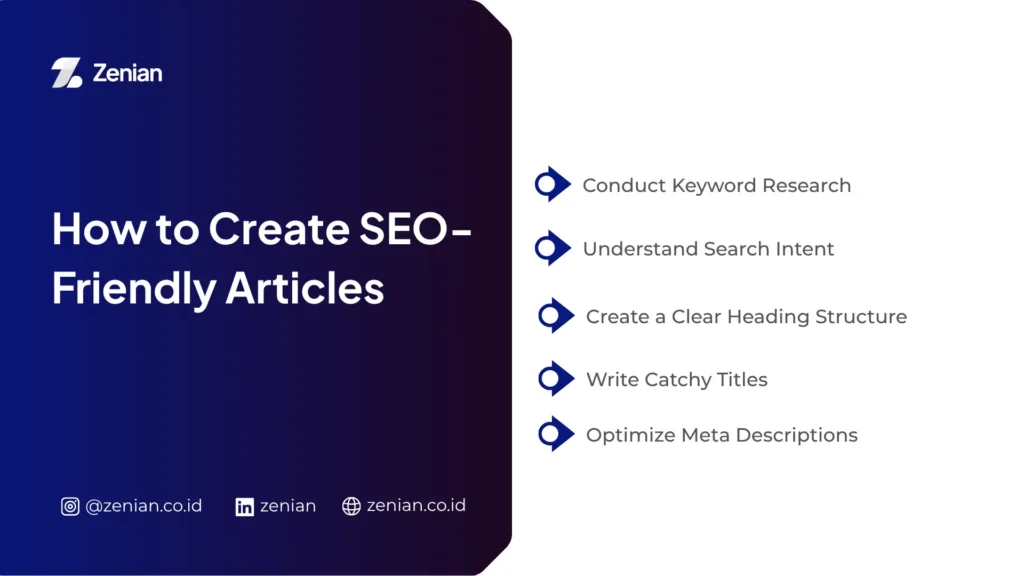
How to Create SEO-Friendly Articles
- Conduct Keyword Research: Use tools like Google Trends, Ahrefs, or SEMrush to understand what users are searching for.
- Understand Search Intent: Is the user looking for information (Informational), trying to buy something (Transactional), or looking for a specific site (Navigational)?
- Create a Clear Heading Structure: Use H1 for the main title, H2 for major topics, and H3 for detailed discussions.
- Write Catchy Titles: The title must include the main keyword and spark human interest.
- Optimize Meta Descriptions: Ensure they are concise, contain keywords, and encourage clicks.
- Use Internal Links: Link to other articles within your website to keep users reading longer.
- Add a CTA (Call to Action): Direct readers to the next step, such as a consultation or service.
Common Mistakes When Writing SEO Articles
- Keyword Stuffing: Inserting too many keywords can lower content quality.
- Ignoring Search Intent: Great articles that don’t answer user needs usually have high bounce rates.
- Messy Content Structure: Long articles without headings cause readers to leave quickly.
- Neglecting Meta Descriptions: This affects the click-through rate (CTR) from search results.
Understanding SEO articles is a vital step in improving website performance. It supports organic traffic, brand credibility, and lead generation.
Want Your Website to Rank on Google?
PT Zenian Digital Lab helps businesses increase organic traffic through SEO strategies, content marketing, and measurable SEO article optimization. Consult your SEO needs with the Zenian team now.
Baca Juga: SEO Article Examples: A Guide to Creating SEO-Friendly Content