
A website with low traffic isn’t always the result of intense competition. In many cases, overlooked issues gradually reduce visitor numbers without business owners realizing it. If left unaddressed, this can significantly limit your opportunities to generate leads and increase sales.
The good news is that every problem has a solution that can be implemented step by step. In this article, you’ll learn the key factors that affect website traffic and discover practical strategies to improve your website’s performance.
Why Does a Website Have Low Traffic?
Low website traffic is a common challenge faced by many businesses. This issue is often caused by limited budgets and insufficient resources to develop effective digital marketing strategies.
The impact goes far beyond declining traffic. A website that attracts few visitors is also likely to generate fewer leads, lower conversion rates, and slower business growth.
8 Reasons Why Your Website Has Low Traffic
Understanding the factors that affect your website’s performance will help you determine the most effective optimization strategy. Here are eight common reasons why your website may not be attracting enough visitors.
1. Your Website Isn’t Optimized for SEO
Search Engine Optimization (SEO) helps search engines understand your website’s content and display relevant pages to users.
Without proper optimization, your website will struggle to compete in search results, even if it offers high-quality products or valuable information.
Approximately 68% of all online experiences begin with a search engine. That’s why it’s important to optimize the fundamental elements of your website. Proper SEO enables search engines to crawl and index your pages more efficiently.
2. You’re Targeting the Wrong Keywords
Targeting high-volume keywords may seem attractive, but it doesn’t always produce results.
If the keywords aren’t relevant to your business or are extremely competitive, ranking for them can be very difficult.
Instead, focus on long-tail keywords, which are more specific and generally have lower competition. These keywords are typically easier to rank for, especially if your website is still new.
You should also understand search intent before creating content.
By identifying what users are actually looking for, you can provide information that directly answers their needs, increasing your chances of achieving higher rankings in search results.
3. Your Content Is Low Quality or Rarely Updated
Content is one of the most important factors influencing website performance.
Google prioritizes informative, original, and helpful content over articles that simply copy information from other sources.
Consistency is equally important.
Websites that rarely publish new content tend to lose visitor interest because users don’t find fresh information.
On the other hand, websites that consistently update their content have greater opportunities to attract and retain visitors.
4. Your Website Loads Too Slowly
Page loading speed has a significant impact on user experience.
If your website takes too long to load, visitors are likely to leave before the page even finishes displaying.
Common causes of slow website performance include:
- Poor-quality web hosting.
- Too many active plugins.
- Large, uncompressed images.
- Unoptimized CSS and JavaScript files.
To improve loading speed:
- Compress images to under 100 KB whenever possible.
- Enable browser caching.
- Optimize your CSS and JavaScript files.
- Use a Content Delivery Network (CDN) if necessary.
5. Your Website Isn’t Mobile-Friendly
Today, the majority of internet users browse websites on smartphones.
For that reason, your website must provide a smooth experience across different screen sizes.
Google also uses mobile-first indexing, meaning the mobile version of your website is the primary version used to determine search rankings.
If visitors struggle to read text, tap buttons, or constantly zoom in to navigate your site, they’re more likely to leave and visit a competitor instead.
6. Your Website Structure Isn’t Well Optimized
A poorly organized website structure makes it difficult for search engines to understand and index your pages.
As a result, important pages may never appear in search results, even if they contain valuable content.
Common technical issues include:
- Incorrect robots.txt settings that block important pages through noindex or disallow directives.
- Poorly configured XML sitemaps, slowing the indexing process.
- Keyword cannibalization, where multiple pages compete for the same keyword.
- Improper redirects, such as incorrect use of 301 or 302 redirect codes.
Performing regular technical SEO audits helps identify and resolve these issues before they negatively impact your website’s performance.
7. You Have Very Few High-Quality Backlinks
Backlinks are links from other websites pointing to your website.
Search engines consider these links as signals that your content is trustworthy and valuable.
However, backlink quality is much more important than quantity.
Links from authoritative websites can improve your site’s credibility, while backlinks from spammy websites may actually harm your rankings.
Build your backlink profile naturally by:
- Publishing high-quality content.
- Writing guest posts.
- Collaborating with reputable websites within your industry.
8. Poor User Experience (UX)
A poor user experience can cause visitors to leave your website within seconds.
This often happens when:
- Navigation is confusing.
- The layout is cluttered.
- There are too many intrusive pop-ups.
Website security also plays an important role.
If your website doesn’t use an SSL certificate (HTTPS), most browsers will mark it as Not Secure.
This warning reduces user trust and may ultimately decrease your organic traffic.
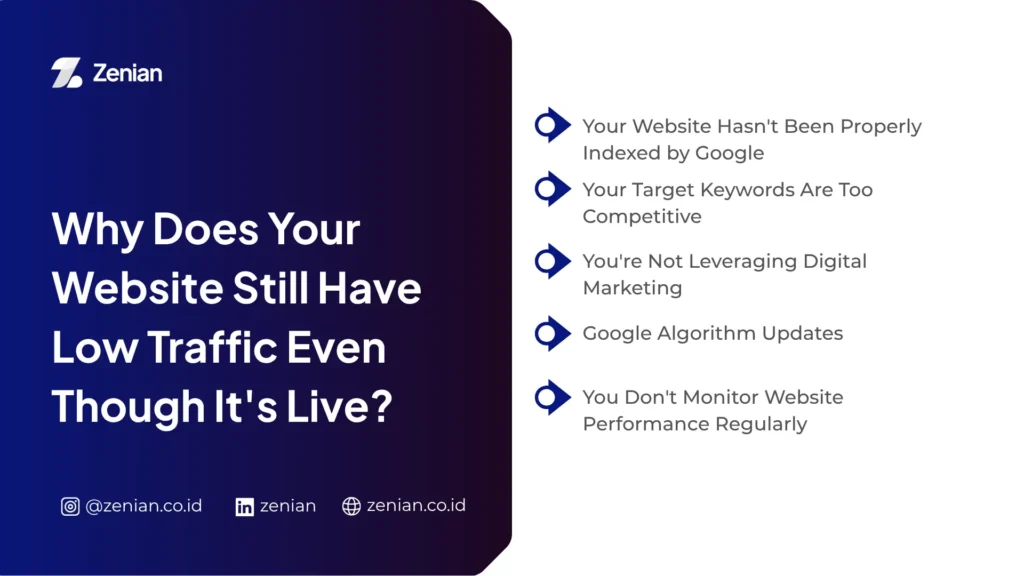
Why Does Your Website Still Have Low Traffic Even Though It’s Live?
Simply publishing a website doesn’t guarantee visitors.
Several factors may prevent your website from attracting organic traffic.
1. Your Website Hasn’t Been Properly Indexed by Google
Google can only display pages that have been successfully indexed.
If indexing doesn’t occur correctly, potential visitors won’t find your website through organic search.
This problem is often caused by incorrect robots.txt settings.
For example, accidentally using noindex or disallow directives may prevent Google’s crawlers from accessing important pages.
2. Your Target Keywords Are Too Competitive
Many website owners immediately target keywords with extremely high search volumes.
Unfortunately, these keywords are usually dominated by large, authoritative websites with strong domain authority.
Instead of competing directly, target more specific long-tail keywords with lower competition.
This approach helps your website reach audiences with clearer search intent while improving your chances of ranking higher.
As your website’s authority grows over time, you can gradually expand your strategy to include more competitive keywords.
3. You’re Not Leveraging Digital Marketing
Even the highest-quality content won’t deliver maximum results without proper promotion. If you don’t actively distribute your content, your target audience simply won’t know your website exists.
You can expand your website’s reach by utilizing various digital marketing channels, including:
- Social media to share content with a broader audience.
- Email marketing to nurture relationships with customers and prospects.
- Paid advertising, such as Google Ads or Facebook Ads, to reach highly targeted audiences.
By combining multiple digital marketing strategies, you can increase brand awareness, expand your content’s reach, and consistently drive more visitors to your website.
4. Google Algorithm Updates
Google regularly updates its search algorithms to ensure users receive the most relevant, accurate, and valuable information.
These updates can significantly impact your website’s rankings, either positively or negatively.
Websites that fail to adapt to algorithm changes often experience declining rankings. For example, content that no longer matches user intent, lacks recent updates, or provides less comprehensive information than competitors will struggle to maintain visibility.
To stay competitive, regularly update your articles, add new information, and ensure every page continues to provide value to your audience.
5. You Don’t Monitor Website Performance Regularly
Regular performance monitoring gives you a complete picture of your website’s health.
Without accurate data, it becomes difficult to determine which optimization strategies are actually working.
Use Google Analytics to monitor:
- Visitor behavior
- Traffic sources
- Most-visited pages
- Conversion rates
These insights can help guide your future optimization efforts.
You should also perform regular technical audits using tools like Google PageSpeed Insights. Routine performance checks help identify issues related to website speed, user experience, and technical SEO before they begin affecting your traffic.
Also Read: 7 Ways to Create a Business Website: A Complete Guide for Beginners
How to Increase Website Traffic
Growing website traffic requires a well-planned strategy and consistent execution.
Here are several proven methods you can implement.
1. Optimize Your On-Page SEO
On-page SEO helps search engines understand your website, making it easier for your pages to appear in search results.
In addition to improving visibility, proper optimization also enhances the user experience.
Focus on optimizing the following elements:
Page Titles and Meta Descriptions
Write concise, compelling title tags and meta descriptions that naturally include your primary keyword.
Place your main keyword near the beginning of the title whenever possible, and keep the title under 55–60 characters to ensure it displays properly in search results.
Website Structure
Organize your content using a logical heading hierarchy (H1, H2, H3, etc.) and include internal links to related pages.
A well-structured website makes it easier for both search engines and users to understand your content.
Image Alt Text
Add descriptive alt text to every image so search engines can understand the visual content while improving your overall SEO.
2. Create Relevant, High-Quality Content Consistently
High-quality content not only attracts visitors but also encourages them to return.
Focus on creating articles that genuinely answer your audience’s questions and solve their problems.
Best practices include:
- Writing informative, original, and valuable content.
- Maintaining content velocity by publishing new articles consistently.
- Avoiding copy-and-paste content.
If you use AI to assist with content creation, always edit and enrich the content with updated information, original insights, and real expertise.
3. Target Keywords That Match Search Intent
Keyword research isn’t just about search volume—it should also align with what users actually want to accomplish.
For better results:
- Understand user intent, whether informational, navigational, or transactional.
- Use long-tail keywords, especially for newer websites, since they typically have lower competition and higher conversion potential.
4. Improve Website Speed
A fast-loading website creates a better user experience and contributes to stronger SEO performance.
Conversely, slow-loading pages often cause visitors to leave before the content even appears.
Improve your website speed by:
- Compressing images to under 100 KB before uploading them.
- Optimizing CSS and JavaScript files.
- Enabling browser caching.
- Using a Content Delivery Network (CDN).
You should also regularly test your website using Google PageSpeed Insights to identify areas that require further optimization.
5. Build High-Quality Backlinks
Backlinks signal to search engines that other websites trust your content.
The higher the quality of your backlinks, the stronger your website’s authority becomes.
For the best results:
- Earn backlinks from reputable, relevant websites.
- Avoid spammy link-building tactics or purchasing low-quality backlinks, as these can negatively impact your rankings.
6. Promote Your Content on Social Media
Social media is an effective way to increase content visibility and attract new website visitors.
The more people who discover and share your content, the greater your opportunity to generate additional traffic.
Promote your latest articles on platforms such as:
- YouTube
- TikTok
Always include links back to your website so users can access more comprehensive information.
7. Use Google Ads to Increase Traffic
If you want faster results while waiting for your SEO strategy to gain traction, consider using Google Ads.
Google Ads allows you to target audiences based on:
- Keywords
- Geographic locations
- Interests
- Demographics
With a well-optimized campaign, paid advertising can increase traffic, generate qualified leads, and improve conversion opportunities.
Signs Your Website Has Low Traffic
Websites with low traffic often struggle to generate conversions.
Visitors may browse your website, but very few complete contact forms, request quotations, or make purchases.
From a technical perspective, you can evaluate your website using metrics such as:
- Engagement time
- Bounce rate
If users visit only one page before leaving, it’s a strong indication that your content, navigation, or overall user experience isn’t meeting their expectations.
For e-commerce websites, another warning sign is low sales volume.
Even if traffic temporarily increases, very few visitors proceed to checkout.
This suggests that your website still contains obstacles preventing users from completing their purchases.
Common Mistakes That Prevent Your Website From Growing
Many websites fail to grow—not because of insufficient promotion—but because they continue making fundamental mistakes in content management and SEO.
Here are the most common issues.
1. Ignoring Keyword Research
Many website owners focus solely on high-volume keywords without considering competition or relevance.
As a result, their content struggles to compete on the first page of search results.
This ultimately causes them to miss valuable opportunities to reach potential customers genuinely interested in their products, services, or information.
2. Publishing Duplicate Content
Content copied from other websites significantly reduces your site’s credibility in the eyes of search engines.
Google prioritizes content that is:
- Original
- Informative
- Valuable
- Helpful
Likewise, publishing AI-generated content without proper editing often results in generic, less useful articles.
Always rewrite, enhance, and expand AI-assisted content by adding updated information and deeper insights.
3. Not Optimizing Meta Titles and Meta Descriptions
Your meta title and meta description are the first elements users see in search results.
If they fail to capture attention, your click-through rate (CTR) will likely decline.
Ensure your title:
- Isn’t too long.
- Includes relevant keywords naturally.
- Clearly describes the page.
Similarly, write concise and persuasive meta descriptions that encourage users to click through to your website.
4. Failing to Update Older Content
Content becomes outdated over time.
Old information reduces reader trust and makes search engines less likely to rank your pages.
Regularly update your articles by:
- Adding new information.
- Revising outdated data.
- Improving overall content quality.
Consistent updates also maintain healthy content velocity, helping search engines recognize that your website remains active.
5. Not Conducting Regular SEO Evaluations
Routine SEO evaluations help you determine which strategies are working and which need improvement.
Without regular analysis, identifying the causes of declining website performance becomes much more difficult.
Use SEO tools and perform technical audits regularly to:
- Monitor website speed.
- Identify problematic pages.
- Evaluate your site’s overall SEO health.
Continuous monitoring allows your website to keep improving over time.
Increase Your Website Traffic with Zenian!
A website with low traffic isn’t a problem that can’t be solved. By strengthening your SEO strategy, improving website speed, publishing high-quality content, and consistently monitoring your website’s performance, you can steadily increase both traffic and long-term conversions.
If you’re looking for the best possible results, trust PT Zenian Digital Lab with your website optimization needs.
Backed by comprehensive 360° Digital Marketing services from Search Engine Optimization (SEO) to Website Development—Zenian helps businesses build data-driven digital strategies focused on increasing traffic, generating qualified leads, and maximizing measurable revenue growth.
Also Read: 4 Practical and Free Ways to Check Website Rankings!