

As digital business competition continues to grow, understanding how to optimize your marketplace store is essential for attracting more customers. Today’s shoppers expect a fast, seamless, and trustworthy shopping experience.
Every aspect of your strategy can influence a customer’s purchasing decision. Proper marketplace optimization also helps your products rank higher through marketplace SEO (Search Engine Optimization), increasing visibility and improving conversion opportunities.
In this guide, you’ll learn effective strategies to make your store more competitive, build customer trust, and generate consistent sales growth.
What Is Marketplace Optimization?
Marketplace optimization refers to a series of strategies designed to improve your store’s visibility on online selling platforms. Its primary goals are to increase product exposure, attract more potential buyers, and drive consistent sales.
Marketplace algorithms evaluate numerous factors, including keyword relevance, product content quality, seller responsiveness, and customer satisfaction. The better your store performs, the greater the likelihood that your products will appear in search results and personalized recommendations.
How to Optimize Your Marketplace Store for Better Visibility
Simply uploading more products isn’t enough to increase your store’s visibility. Instead, implement the following strategies.
1. Conduct Product Keyword Research
Start by identifying the keywords that shoppers frequently use when searching for products like yours. Understanding real customer search behavior helps your products appear more often in relevant search results.
Take advantage of your marketplace’s search suggestion feature to discover keyword ideas.
For more comprehensive keyword research, use tools such as Semrush to identify high-potential keywords, including long-tail keywords. Although these keywords generally have lower search volumes, they also have lower competition and often deliver higher conversion rates.
2. Create SEO-Friendly Product Titles
Your product title is one of the first elements evaluated by both marketplace algorithms and potential buyers.
Create titles that are:
- Clear
- Informative
- Easy to understand
Place your primary keyword at the beginning of the title, then include important details such as:
- Product type
- Size
- Color
- Material
- Key features or selling points
Avoid keyword repetition, excessive symbols, or irrelevant wording, as these can reduce your product’s search performance.
3. Write Informative Product Descriptions
Your product description helps potential buyers understand exactly what they’re purchasing. The more complete your information is, the easier it becomes for customers to make purchasing decisions.
To improve readability, organize important information using bullet points, including:
- Product specifications
- Primary functions or benefits
- Usage instructions
- Dimensions or sizing
- Materials
- Package contents
- Care instructions (if applicable)
Detailed product descriptions also reduce repetitive customer inquiries while increasing trust in your store.
4. Use High-Quality Product Photos and Videos
Visual content is one of the most influential factors affecting purchase decisions.
Use high-resolution product images with proper lighting, and display the product from multiple angles so customers can clearly examine every detail.
Additionally, include product videos demonstrating:
- Product functionality
- Size
- Usage
- Key features
Videos can significantly improve click-through rates (CTR) while giving customers a more realistic understanding of your product quality.
5. Choose the Correct Product Category and Attributes
Always place products in the most appropriate category.
This helps the marketplace algorithm display your products to the right audience when customers search.
Complete every available product attribute, including:
- Brand
- Size
- Color
- Material
- Product variations
Complete product information also allows customers to use marketplace filters more effectively, increasing your chances of being discovered.
6. Complete Your Store Profile
A complete store profile creates a professional impression while increasing customer trust.
Make sure your profile includes:
- A clear company logo
- An attractive store banner
- A compelling business description explaining your brand and competitive advantages
Whenever possible, also include:
- Business address
- Operating hours
- Contact information
A well-maintained profile demonstrates that your business is professionally managed.
7. Improve Customer Ratings and Reviews
Customer reviews are one of the first things shoppers evaluate before making a purchase.
Deliver excellent customer service to encourage satisfied buyers to leave positive reviews.
Don’t focus solely on positive feedback.
Respond to every review—including complaints—politely, promptly, and with practical solutions.
Professional responses show that your business values customer satisfaction and actively protects its reputation.
8. Maintain Excellent Store Performance and Fast Response Times
Marketplace platforms also evaluate your operational performance.
Respond to customer messages as quickly as possible so shoppers feel valued and supported.
Additionally:
- Keep inventory updated.
- Ship orders on time.
- Minimize order cancellations.
Strong operational performance improves your marketplace rating while maintaining favorable algorithm performance.
9. Join Free Shipping and Marketplace Promotional Campaigns
Take advantage of promotional programs offered by your marketplace to expand your product reach.
Popular promotional programs include:
- Flash Sales
- Discount vouchers
- Free shipping campaigns
Marketplaces also tend to provide greater visibility to stores actively participating in promotional events.
The more frequently your store joins official campaigns, the higher your chances of appearing in search results and recommendation pages.
10. Utilize Marketplace Advertising
Don’t rely exclusively on organic search traffic.
Use your marketplace’s advertising tools to reach a larger audience.
Automatic advertising features can display your products to shoppers whose interests match your offerings without requiring complex campaign management.
You can also drive external traffic from platforms such as:
- Facebook Ads
- Google Search
- TikTok Ads
Combining marketplace advertising with external traffic sources significantly increases your sales opportunities.
Also Read: 7 Ways to Create a Business Website: A Complete Guide for Beginners
Free Marketplace Optimization Tips to Increase Sales
You don’t always need to spend money on advertising to increase marketplace sales.
The following free optimization strategies can help your products gain better visibility.
1. Include Keywords in Your Product Name
Once you’ve identified the right keywords, place your primary keyword at the beginning of your product title so the marketplace algorithm can easily recognize its relevance.
Then include additional information such as:
- Product type
- Size
- Color
- Material
- Key selling points
This allows customers to immediately understand your product without opening the product page.
2. Upload Products Consistently
Marketplace algorithms generally reward active sellers.
Regularly upload new products while updating your existing listings.
In addition to adding products, routinely review:
- Inventory
- Pricing
- Product images
- Product descriptions
This demonstrates that your store is actively maintained while helping preserve product visibility.
Creating a monthly schedule for new product uploads, catalog updates, and seasonal promotions also keeps your store consistently active.
3. Take Advantage of the “Boost Product” Feature
Most marketplaces offer free features that temporarily improve your product’s search ranking.
Many platforms allow sellers to boost products every 4 hours.
Use this feature consistently, especially for your best-selling or highest-potential products.
Better positioning increases impressions, clicks, and sales without additional advertising costs.
4. Offer Competitive Pricing
Price remains one of the biggest factors influencing purchase decisions.
Research competitors selling similar products to understand the current market price range.
However, competitive pricing doesn’t always mean offering the lowest price.
You can justify a slightly higher price by providing added value, such as:
- Better product quality
- Product warranties
- Purchase bonuses
- Responsive customer service
Clearly communicate these advantages in your product description.
5. Optimize Your Product Thumbnail
Your product thumbnail is often the first thing shoppers notice.
Use high-quality product photos with:
- Clean backgrounds
- Professional composition
- Multiple viewing angles
Avoid blurry, dark, or low-resolution images, as they can reduce buyer confidence before they even read your product description.
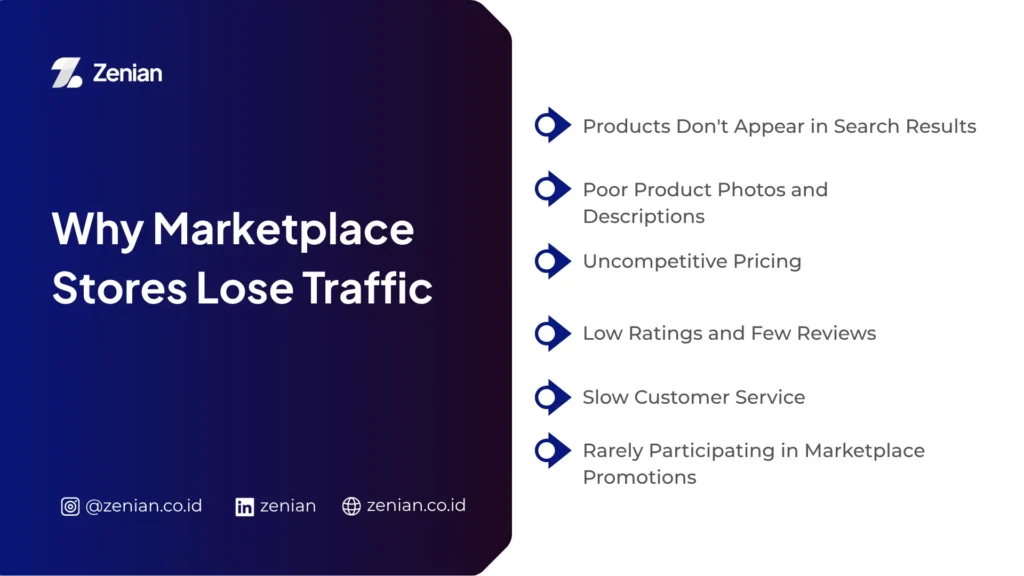
Why Marketplace Stores Lose Traffic
A decline in visitors doesn’t always mean your products are poor quality.
In many cases, traffic decreases because the store hasn’t been optimized effectively.
1. Products Don’t Appear in Search Results
Products that rarely appear in search results receive significantly less attention.
This often happens because the seller hasn’t implemented effective marketplace SEO, particularly keyword optimization based on customer search behavior.
2. Poor Product Photos and Descriptions
Product presentation strongly influences purchasing decisions.
Blurry photos, poor lighting, or unattractive layouts can discourage buyers before they even open your product page.
Complement your images with videos showing:
- Product details
- Dimensions
- Usage
- Overall quality
Then create informative product descriptions covering:
- Features
- Benefits
- Specifications
- Usage instructions
3. Uncompetitive Pricing
Price competition is intense because many sellers offer similar products.
If your prices are significantly higher without clearly demonstrating additional value, customers are more likely to purchase elsewhere.
Instead of competing solely on price, add value through:
- Better customer service
- Purchase bonuses
- Premium packaging
- Product warranties
- After-sales support
4. Low Ratings and Few Reviews
Most shoppers read reviews before checking out.
Low ratings or numerous negative reviews reduce buyer confidence.
Deliver outstanding customer service to encourage satisfied customers to leave positive feedback.
Respond professionally to both positive and negative reviews.
Consistent engagement strengthens customer trust and enhances your reputation.
5. Slow Customer Service
Fast response times significantly improve sales opportunities.
When customers wait too long for answers, they often purchase from competitors instead.
Respond promptly and professionally to:
- Customer messages
- Product questions
- Marketplace discussions
Reliable internet connectivity and well-managed notifications help prevent missed inquiries.
6. Rarely Participating in Marketplace Promotions
Marketplaces provide numerous promotional opportunities to help sellers attract more buyers.
Unfortunately, many stores rarely join programs such as:
- Flash Sales
- Discount vouchers
- Free shipping campaigns
Stores actively participating in these promotions typically receive greater visibility in search results and recommendation sections.
Marketplace Optimization Mistakes to Avoid
Several common mistakes can reduce your product visibility despite your optimization efforts.
1. Keyword Stuffing in Product Titles
Keywords improve discoverability—but using too many makes your titles appear spammy and difficult to read.
Keyword stuffing also creates a poor shopping experience and may reduce your product’s ranking.
2. Using Low-Quality Product Images
Customers almost always examine product images before reading descriptions.
Avoid using photos that are:
- Blurry
- Dark
- Pixelated
- Poorly lit
Professional product photography greatly improves buyer confidence.
3. Ignoring Customer Questions
Quick responses demonstrate that your store is active and customer-focused.
Leaving questions unanswered often causes shoppers to lose interest and purchase from another seller.
Always reply politely, clearly, and helpfully.
Also respond to reviews after completed purchases to strengthen customer relationships.
4. Failing to Monitor Store Performance
Many sellers focus only on sales without analyzing store performance.
Regular monitoring helps identify which strategies work and which require improvement.
Track important metrics such as:
- Store visitors
- Conversion rate
- Advertising performance
- Best-selling products
- Keyword effectiveness
These insights enable smarter marketing decisions and continuous optimization.
5. Relying Solely on Organic Marketplace Traffic
Depending only on organic traffic often limits long-term growth, especially in highly competitive marketplaces.
While organic optimization remains essential, combine it with other promotional strategies.
Utilize:
- Marketplace advertising
- Social media marketing
- Website traffic
- Other digital marketing channels
Driving traffic from multiple sources creates more consistent sales opportunities.
Grow Your Marketplace Sales with Zenian
Successfully optimizing a marketplace store requires a consistent, data-driven strategy. Instead of simply following trends, every optimization effort should be based on measurable insights that support long-term business growth.
Through our 360° Digital Marketing Services, customized business strategies, and a results-driven approach focused on increasing leads and revenue, PT Zenian Digital Lab is ready to become your trusted growth partner.
Consult with the Zenian team today and discover how we can help your marketplace store become easier to find, more trusted by customers, and consistently generate higher sales.
Also Read: 8 Benefits of SEO for Businesses in the Digital Era