
Many business owners begin their online selling journey through marketplaces. The reason is simple: it’s easy, fast, and doesn’t require building a website from scratch. However, as a business grows, a common question starts to emerge: should you continue focusing on marketplaces, or is it time to build your own ecommerce website?
This question is closely related to the difference between marketplace and ecommerce, a topic that is still widely misunderstood. At first glance, both are used for selling products online. But when you take a closer look, there are significant differences that can impact your marketing strategy, customer experience, and long-term business growth.
If you’re currently evaluating the next step for your online business, understanding these differences can help you make a more informed decision.
Marketplace and Ecommerce: Are They the Same?
Many people use the terms marketplace and ecommerce interchangeably. In reality, they represent two different business models.
Before diving deeper, let’s start with the basics.
What Is a Marketplace?
Simply put, a marketplace is a platform that connects multiple sellers and buyers in one place.
Popular examples include Shopee, Tokopedia, Lazada, and Bukalapak. Within these platforms, thousands or even millions of stores offer products across various categories.
When you open a store on a marketplace, all you need to do is upload your products and start selling. Payment processing, shipping systems, and promotional tools are largely provided by the platform itself.
Because of this convenience, marketplaces are often the first choice for businesses entering online sales.
What Is Ecommerce?
Unlike a marketplace, ecommerce refers to an online store or website that is owned and managed directly by a business.
A good example is a brand’s official online store, where products are sold exclusively without sharing space with competitors.
Through an ecommerce website, businesses have complete control over website design, user experience, marketing strategies, and customer data.
This is why many companies view ecommerce as a valuable long-term digital asset.
What Is the Difference Between Ecommerce and Marketplace?
When discussing the difference between ecommerce and marketplace, the key distinctions lie in platform ownership, business control, and customer relationship management.
Marketplaces offer convenience because the entire infrastructure is already in place. Ecommerce, on the other hand, provides greater flexibility to develop your business according to your specific goals.
Think of a marketplace as renting a kiosk inside a shopping mall.
An ecommerce website is more like owning your own store, which you can design, manage, and expand based on your business vision.
To make the comparison easier to understand, here’s a side-by-side breakdown:
| Aspect | Marketplace | Ecommerce |
|---|---|---|
| Definition | A platform that connects multiple sellers and buyers in one place. | A website or online store owned and managed by a single business or brand. |
| Platform Ownership | Owned by third parties such as Shopee, Tokopedia, or Lazada. | Fully owned and controlled by the business. |
| Branding | Limited because customers tend to remember the platform rather than the individual store. | Stronger because the entire experience is centered around your brand. |
| Competition | High, since multiple sellers often offer similar products within the same platform. | Lower, as customers only see products from your brand. |
| Customer Data | Limited access to customer information. | Full access to customer data and purchasing behavior. |
| Initial Cost | Relatively low and easy to get started. | Requires investment in domain registration, hosting, and website development. |
| Traffic | Already benefits from the platform’s existing audience. | Traffic must be generated through SEO, advertising, and digital marketing efforts. |
| Feature Flexibility | Restricted to the features and rules provided by the platform. | Can be customized according to business needs. |
| Customer Relationship | Customer relationships are largely controlled by the marketplace. | Businesses can build direct relationships with customers. |
| Long-Term Potential | Ideal for generating sales quickly. | Better suited for building a long-term digital asset and sustainable business growth. |
In simple terms, marketplaces are ideal for businesses that want to start selling quickly without worrying about technical setup. Ecommerce, meanwhile, is a better fit for businesses looking to strengthen their brand identity, own their customer data, and implement more flexible marketing strategies.
For this reason, many growing businesses choose to use both. Marketplaces help them reach a wider audience, while ecommerce serves as the hub for branding and customer management.
Which One Makes It Easier to Get Traffic?
When it comes to traffic, marketplaces definitely have an advantage.
Large platforms such as Shopee and Tokopedia attract millions of visitors every day. This means products have a higher chance of being discovered by potential customers, especially for businesses that are just starting out.
Ecommerce websites, on the other hand, require more effort to generate traffic.
Businesses typically need to invest in SEO, digital advertising, content marketing, and social media strategies to attract a steady flow of visitors.
However, there is one important advantage that is often overlooked.
When customers visit your ecommerce website, their attention is focused entirely on your products and brand. There are no competitor stores displayed right next to your product listings.
Which Option Is More Cost-Effective?
Marketplaces often appear more affordable in the beginning because there are no website development costs.
As sales increase, however, businesses usually face administrative fees, platform commissions, advertising costs, and various additional charges.
Ecommerce requires an upfront investment for domains, hosting, website design, and technical management.
Even so, ecommerce often delivers better profit margins over time because businesses have greater control over pricing, marketing strategies, and customer retention.
This is one reason why many major brands continue to maintain their own ecommerce websites, even while selling through marketplaces.
When Should You Use a Marketplace?
A marketplace is a suitable option if you:
- Are just starting an online business
- Want to test the market quickly
- Have a limited budget
- Do not yet have a digital marketing team
For many businesses, marketplaces provide an effective starting point for gaining customers and generating initial sales.
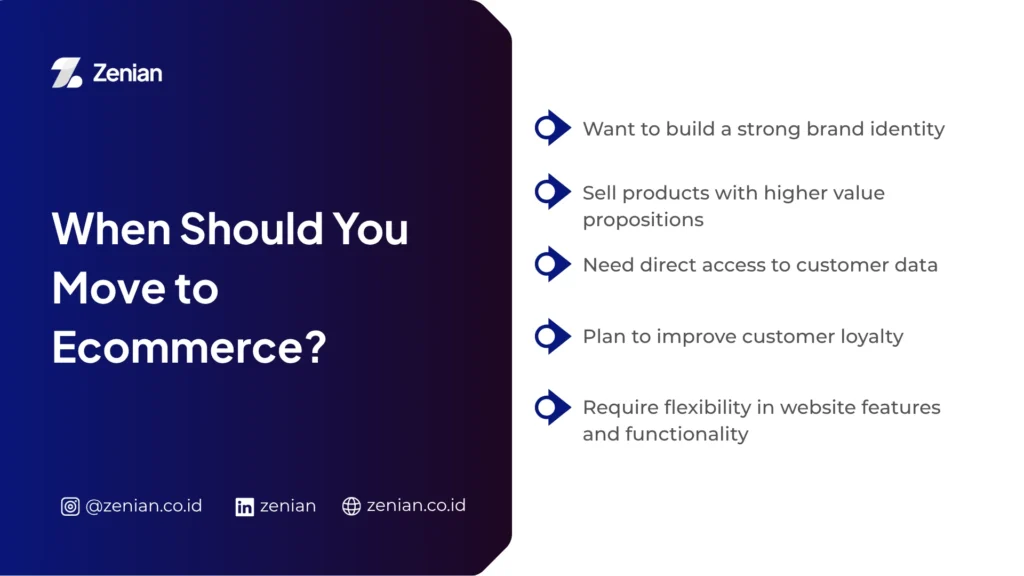
When Should You Move to Ecommerce?
Ecommerce becomes a stronger option when your business begins to grow and you’re ready to build your own digital asset.
Typically, ecommerce is a good fit for businesses that:
- Want to build a strong brand identity
- Sell products with higher value propositions
- Need direct access to customer data
- Plan to improve customer loyalty
- Require flexibility in website features and functionality
As a result, many businesses adopt a hybrid strategy, continuing to sell through marketplaces while developing their ecommerce website as the center of their digital presence.
So, Which One Is Better?
The answer depends on your business goals.
If your primary objective is to generate sales quickly with minimal investment, a marketplace may be the right choice.
However, if you want to strengthen your brand, gain full control over customer relationships, and build a sustainable business, ecommerce offers greater long-term opportunities.
In practice, many successful businesses leverage both channels simultaneously. Marketplaces help expand reach and attract new customers, while ecommerce serves as the foundation for branding, customer engagement, and long-term growth.
Build a Professional Ecommerce Website with Zenian
Understanding the difference between marketplace and ecommerce is the first step toward creating the right online business strategy. However, having an effective ecommerce platform involves much more than simply launching a website.
Your website should have a well-structured design, fast loading speed, mobile-friendly functionality, an intuitive user experience, and strong SEO performance to help customers find your business on Google.
PT Zenian Digital Lab is ready to help you build a professional ecommerce website designed to support business growth, strengthen brand credibility, and generate more sales. From website design and development to SEO optimization, every solution can be tailored to your business objectives.
Consult with Zenian today and start building a digital asset that can continue growing alongside your business for years to come.
Also Read: 8 Benefits of SEO for Businesses in the Digital Era