
Content marketing is a widely used strategy among businesses to capture customer attention in this digital era. Far beyond just creating content, this strategy helps brands build closer relationships with their audience.
However, how do you implement it to achieve optimal results? In this article, you will learn the definition of content marketing, effective strategies, and various implementation examples to help your business grow more competitively.
What Is Content Marketing?
Content marketing is a marketing strategy focused on creating and distributing valuable content to attract, engage, and retain a target audience. Through this approach, businesses offer products and services while providing solutions or education that help the audience.
Unlike conventional advertising that often displays sales messages overtly, content marketing prioritizes a more natural relationship with the audience. Consequently, this strategy is highly utilized in today’s digital era.
Understanding Content Marketers: Roles and Responsibilities
With the rising demand for digital content, companies need professionals who can strategically design, create, and manage various types of content. These professionals are known as content marketers.
1. Duties of a Content Marketer
The responsibilities of a content marketer span interconnected creative and analytical activities, including:
- Creating high-quality content across various formats, such as blog articles, social media posts, infographics, videos, and e-books.
- Developing content strategies aligned with the target audience and the company’s marketing goals.
- Distributing and promoting content through various digital channels, including social media, email marketing, and paid advertising.
- Analyzing content performance using various analytical tools to measure the effectiveness of active campaigns.
- Conducting keyword and audience research to ensure content remains relevant and easily discoverable on search engines.
- Collaborating with design, SEO, and marketing teams to produce optimized campaigns.
2. Essential Skills for a Content Marketer
To produce content that can grab attention while driving business impact, a content marketer needs to master several critical skills:
- Good communication skills to convey messages clearly to both the audience and internal teams.
- Strong writing skills to generate informative, persuasive, and easy-to-understand content.
- Storytelling ability to package information into something more engaging and memorable.
- Creativity in developing content ideas that match market needs.
- Basic SEO understanding so that content stands a better chance of appearing on search engine results pages.
- Data analysis skills to evaluate content performance and determine necessary improvement steps.
- Sensitivity to industry trends and audience behavior, ensuring the content strategy remains relevant over time.
Baca Juga: How to Advertise on Google: A Complete Guide for Beginners
3. The Role of Content Marketers in Digital Marketing
Within the digital marketing ecosystem, content marketers play a vital role in building relationships between brands and prospective customers. This role spans various stages of the consumer journey, before and after a purchase.
- Increasing audience awareness regarding the products, services, or solutions offered by the company.
- Providing information that helps prospective customers consider various options before making a decision.
- Driving conversions through content that addresses the needs and hesitations of the audience.
- Supporting SEO strategies by delivering quality content that has the potential to drive sustainable organic traffic.
- Enhancing engagement through interesting, informative, and relevant content tailored to the target market.
- Helping build customer loyalty by delivering a consistent experience across various digital channels.
Functions and Benefits of Content Marketing
When a business consistently delivers relevant and useful content, the audience recognizes the brand more easily. Here are some functions and benefits obtained from implementing content marketing:
1. Increasing Brand Awareness
Engaging content can help a business reach more people and introduce the brand to a wider audience. The more frequently the audience finds relevant content, the higher the chance they will remember the brand name.
For instance, a company can share educational articles, infographics, videos, podcasts, or e-books that fit the needs of its target market. This way, the brand maintains a constant presence in the minds of the audience without relying on aggressive promotion. When prospective customers need a specific product or service in the future, they tend to choose a brand they have frequently seen and recognized before.
2. Driving Organic Website Traffic
Quality content is a key factor in attracting visitors from search engines. When a business creates articles that answer the audience’s questions or needs, the chances of appearing in search results increase significantly.
Applying proper SEO strategies also helps search engines understand the topics discussed on a page. As a result, the website can secure sustainable organic traffic without having to continuously rely on paid advertising. In addition to increasing visitor numbers, organic traffic is generally of better quality because it comes from users who are actively searching for information related to that topic.
3. Supporting Lead Generation and Conversion
Content does not just serve to grab attention; it also helps convert visitors into prospects and loyal customers. This process occurs when a business provides the information the audience needs at every stage of the buying journey.
For example, a user might first discover an educational article, then read a case study, download an e-book, and ultimately decide to buy the product or use the service offered.
4. Building Credibility and Audience Trust
Audiences tend to trust brands that can provide useful solutions and insights. Therefore, informative content helps companies demonstrate competence and experience in their respective fields.
When a business regularly shares in-depth articles, practical guides, research findings, or other educational materials, the audience views the brand as a reliable source of information. Trust built over time creates long-term relationships, which frequently become a vital factor in a customer’s purchasing decisions.
5. Supporting Long-Term SEO Strategies
Unlike advertisements that stop producing results once the budget runs out, content can continue to provide long-term benefits. This is especially true if a business creates evergreen content—content that remains relevant long after its publication date.
Well-optimized articles, guides, or educational pages can continuously show up in search results and generate organic traffic for months or even years. Furthermore, high audience engagement levels, such as long reading times and active interactions, signal positive metrics to search engines, boosting website visibility and strengthening long-term SEO performance.
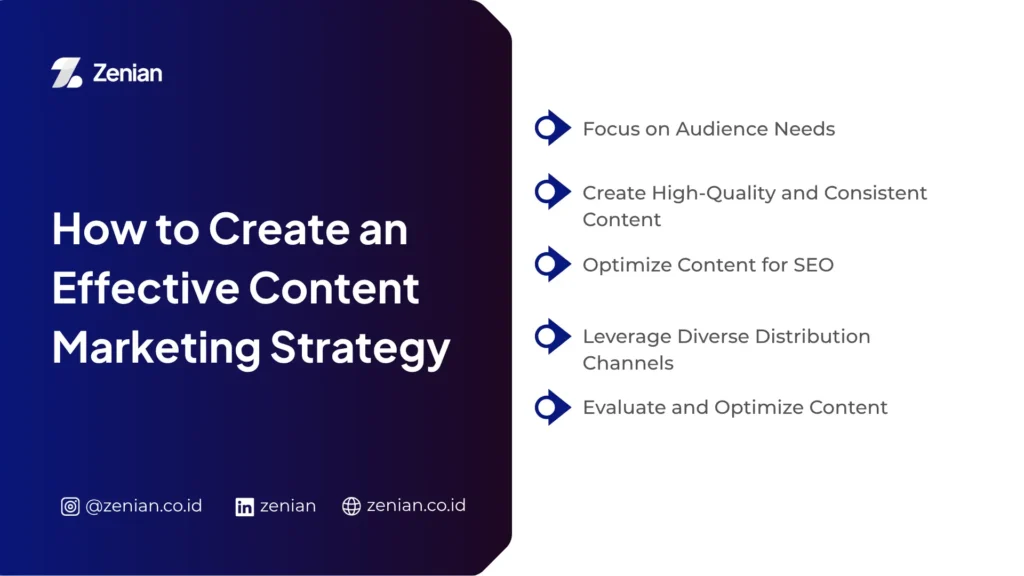
How to Create an Effective Content Marketing Strategy
Every piece of content must have a clear objective, address audience needs, and support the business goals you want to achieve. Here are several effective methods to consider:
1. Focus on Audience Needs
The first step is to understand exactly who your target audience is. Audiences usually look for solutions to specific problems or require information relevant to their needs.
Therefore, conduct research through customer surveys, industry trend analysis, or by observing competitor audience behavior. The better your understanding of their needs, the greater your chances of grabbing attention and building a stronger connection.
2. Create High-Quality and Consistent Content
Quality content provides tangible value to the reader. Besides being relevant to audience needs, content must also be informative, trustworthy, unique, and capable of driving emotional engagement.
However, quality alone is not enough if it is not balanced with consistency. Publish content regularly so the audience continuously recognizes and remembers the brand. Consistency also helps build long-term credibility.
3. Optimize Content for SEO
Good content needs to be easily found by prospective customers. Because of this, Search Engine Optimization (SEO) is an essential component of a content marketing strategy. With the right optimization, content has the potential to rank at the top of search engine pages and bring in continuous organic traffic.
4. Leverage Diverse Distribution Channels
High-quality content will not yield maximum results if published on only one platform. Therefore, leverage various distribution channels to reach a broader audience.
Choose distribution channels that align with the characteristics of your target audience to ensure the message is conveyed effectively. This strategy also helps boost website traffic, strengthen social media brand presence, and support other digital marketing activities.
5. Evaluate and Optimize Content
After content is published, perform regular evaluations to determine the effectiveness of the strategy. Data analysis helps identify the types of content the audience prefers as well as areas that still require improvement.
Through a continuous process of evaluation and optimization, businesses can produce increasingly relevant content, improve lead quality, and drive revenue growth more effectively.
Frequently Used Content Marketing Examples
Content formats are chosen to match the characteristics of the target market, the platform used, and the message to be conveyed. Here are some of the most common content marketing examples used by businesses:
1. SEO-Friendly Blog Articles
Blog articles are one of the most popular forms of content marketing because they can drive continuous traffic to a website. Implementing SEO makes it easier for prospective customers to find these articles when searching for specific information online.
Aside from educating readers, blog articles can also direct them to product or service pages via relevant internal links. Many companies leverage this strategy to build credibility while boosting conversion opportunities.
2. Social Media Content
Social media serves as an effective channel for building closer relationships with the audience. Platforms like Facebook, Instagram, X, LinkedIn, and TikTok allow businesses to deliver messages quickly and interactively.
The content shared varies widely, ranging from carousels, image posts, threads, and reels to stories. Through social media, the audience can provide immediate feedback through comments, likes, and shares.
3. Email Marketing Content
Email marketing helps businesses maintain more personalized communication with customers. Through email, companies can share the latest updates, educational articles, promotions, or special offers directly to the audience’s inbox.
This strategy allows businesses to remain top-of-mind without aggressive selling. By delivering relevant and useful content, companies can build trust and enhance customer loyalty.
4. Video Marketing Content
Video is a highly sought-after content format because it can convey information in a more engaging and easy-to-understand manner. The audience can grasp messages quickly through a combination of visuals, sound, and text delivered in a single medium. Platforms like YouTube also offer massive opportunities to reach a broader audience and build a loyal brand community.
5. E-books and Whitepapers
E-books and whitepapers are usually targeted at audiences who need more in-depth information regarding a specific topic. This format allows businesses to explain a subject comprehensively compared to standard articles. Besides serving as an educational medium, e-books also help strengthen a business’s positioning as a credible source of information.
6. Infographics and Visual Content
Infographics help simplify complex information so that it is easier to digest. By combining data, illustrations, icons, and concise text, visual content can convey messages rapidly to the audience. This format is ideal for explaining statistics, workflows, research results, or other vital information that might be difficult to understand through text alone.
Grow Your Business Content Marketing with Zenian
Content marketing helps businesses build trust, increase visibility, and create long-term relationships with customers. However, to achieve optimal results, every strategy must be designed based on business goals and accurate data.
You can partner with PT Zenian Digital Lab to make it happen. With a track record of over 100 completed projects and more than 5,000 successful leads generated, we are ready to help accelerate your digital business growth!
Read Too: What is a Lead? Definition, Functions, and How to Generate Leads