
Conversion rate is a critical indicator that helps you understand how effectively your digital marketing strategy drives desired actions. Simply attracting visitors to your website is not enough if they do not interact with it.
Therefore, understanding how conversions work is essential for optimizing overall business performance. By doing so, you can increase the chances of turning visitors into customers while maximizing the value of every marketing effort you make.
What Is Conversion Rate?
Conversion rate is the percentage of visitors who successfully complete a specific action that aligns with your business goals or marketing campaigns. These actions can include purchasing a product, signing up for a newsletter, filling out a contact form, or downloading an e-book.
This metric helps businesses evaluate how effectively a website, landing page, or marketing campaign converts visitors into customers or prospects. The higher the conversion rate, the greater the opportunity for a business to generate revenue from its traffic.
The Conversion Rate Formula
Generally, the calculation is done by comparing the number of conversions against the total audience used as the baseline, and then multiplying that number by 100%.
The core formula is:
$$\text{Conversion Rate} = \left( \frac{\text{Total Conversions}}{\text{Total Visitors}} \right) \times 100\%$$
1. How to Calculate Conversion Rate
To ensure accurate results, follow these steps:
- Define the conversion goal you want to achieve (e.g., sales, account registrations, or form submissions).
- Collect data on the number of visitors, sessions, or leads using analytics tools like Google Analytics.
- Record the number of successful conversions achieved within a specific period.
- Plug the data into the formula above.
- Multiply the result by 100 to get the percentage value.
2. Conversion Rate Calculation Examples
Here are a few simple examples to make it easier to understand:
- Case 1: An online store gets 10,000 visitors and generates 200 purchases.$$(200 \div 10,000) \times 100\% = 2\%$$The resulting conversion rate is 2%.
- Case 2: A business landing page receives 13,000 visits and generates 2,600 desired actions.$$(2,600 \div 13,000) \times 100\% = 20\%$$The conversion rate reaches 20%.
3. How to Interpret Conversion Rate Correctly
Once you have the conversion figures, the next step is to fully understand their meaning. While a high number indicates good performance, interpretation must still consider several key factors:
- Compare with Industry Benchmarks: Every industry has a different average conversion rate. For context, the e-commerce sector generally has a conversion rate of around 1–3%, while B2B and SaaS businesses often range between 2–5%.
- Monitor Long-Term Trends: Do not just focus on daily or weekly changes. Analyze long-term trends to see if your website’s performance is steadily improving, stabilizing, or declining.
- Evaluate Traffic Quality: High traffic does not automatically mean high conversions. Conversely, lower traffic that comes from the right target audience often yields much better results.
- Combine with Other Metrics: Conversion figures become more meaningful when analyzed alongside other metrics, such as Cost Per Acquisition (CPA), Average Order Value (AOV), and Return on Investment (ROI).
5 Types of Conversions in Digital Marketing
Broadly speaking, conversions are divided into two main categories: macro-conversions and micro-conversions. The specific types are explained below:
1. Website Conversions
To measure overall effectiveness, many businesses use the Overall Conversion Rate metric, which shows how successfully the entire website encourages visitors to take action. Common website conversions include:
- Opening a marketing email and clicking a link.
- Downloading digital assets like brochures, catalogs, or e-books.
- Registering a new account or subscribing to a newsletter.
- Contacting the business via phone, email, or a provided contact form.
The more visitors who take these actions, the greater the business’s opportunity to build relationships with potential customers and boost sales.
2. Landing Page Conversions
Landing pages are designed for more specific goals compared to regular website pages. Therefore, measuring conversions on these pages usually relies on the Page-Level Conversion Rate for more accurate and focused results.
When visitors land on a landing page, businesses typically direct them toward one primary action, such as:
- Filling out a form to capture lead data.
- Clicking a Call-to-Action (CTA) button to move to the next page.
- Signing up for a service, attending a webinar, or downloading a special offer.
3. E-Commerce Conversions
In e-commerce, conversions are directly tied to the customer’s shopping journey. While the ultimate goal is a sale, there are several key stages to monitor:
- Product purchases (the primary conversion).
- Adding products to the shopping cart (a supporting conversion).
- Completing the checkout process through a successful payment.
- Joining a customer loyalty program.
- Placing an online order through an integrated system.
4. Google Ads and Social Media Ads Conversions
Paid advertising campaigns have their own set of conversion metrics, typically measured via the Campaign Conversion Rate. This helps businesses understand whether their ad spend is actually generating valuable actions. Common ad conversions include:
- Ad clicks that lead directly to a product purchase.
- Account registrations or form completions on a landing page.
- Conversions stemming from specific keywords via pay-per-click (PPC).
- The success of retargeting campaigns in re-engaging past visitors who haven’t yet converted.
5. Lead Generation as a Form of Conversion
Lead generation is the process of converting visitors into potential prospects. This type of conversion is vital for businesses that rely on long sales cycles, particularly in the services and business-to-business (B2B) sectors. This is typically done by:
- Collecting data via contact or registration forms.
- Offering incentives like discounts, free consultations, or exclusive content.
- Encouraging visitors to provide information that can be used in subsequent marketing efforts.
Read Too: How to Calculate ROAS to Optimize Your Business Ads
What Is Conversion Rate Optimization (CRO)?
Conversion Rate Optimization (CRO) is the process of analyzing visitor behavior and improving the quality of their experience when interacting with a website. This approach relies on real data so that decisions are not made based on mere assumptions.
In practice, CRO usually involves the following stages:
- Research and Analysis: Understanding visitor behavior through heatmaps, surveys, and analytics reports.
- Hypothesis Formulation: Creating theories based on findings, such as changing button designs or simplifying forms.
- Testing: Using methods like A/B testing to determine which page version yields the best results.
- Evaluation and Continuous Improvement: Making ongoing adjustments to ensure website performance improves over time.
Goals of Conversion Rate Optimization
CRO helps businesses ensure that every digital marketing element works optimally and delivers measurable results. This strategy does not just chase higher conversion numbers; it also helps businesses understand their audience’s needs on a deeper level.
Key goals of CRO include:
- Increasing the number of visitors who respond to a Call to Action (CTA).
- Understanding visitor interaction patterns when browsing the website.
- Identifying bottlenecks that cause visitors to leave a page without taking action.
- Evaluating the effectiveness of marketing campaigns and finding areas for improvement.
Benefits of CRO for Businesses and Websites
Consistently implementing CRO can have a highly positive impact on business growth. Beyond increasing conversions, it creates a better user experience and improves marketing efficiency.
Benefits include:
- Increased revenue and profit, as more visitors turn into paying customers.
- Optimized marketing budgets, making the Cost Per Acquisition (CPA) much more efficient.
- Enhanced User Experience (UX) through easier navigation, relevant content, and simpler transaction processes.
- Boosted SEO performance, because visitors tend to spend more time on a website that is user-friendly.
- Built customer loyalty, especially when the buying process is quick, easy, and satisfying.
- Data-driven insights, allowing businesses to craft more accurate strategies tailored to market needs.
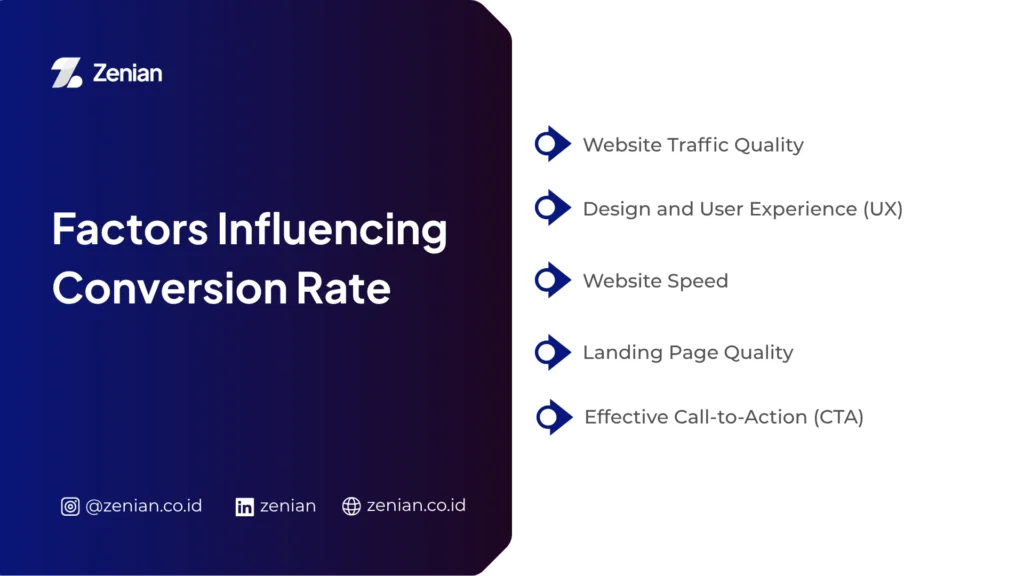
Factors Influencing Conversion Rate
Improving your conversion rate requires more than just driving mass traffic to your website. Here are the core factors you need to address:
1. Website Traffic Quality
Traffic quality is one of the most influential factors. The more relevant the visitors coming to your site, the higher the likelihood they will make a purchase, fill out a form, or sign up for services. Even if the visitor volume is modest, high-quality traffic usually yields optimal results and significantly increases Return on Investment (ROI).
2. Design and User Experience (UX)
When visitors can navigate a page seamlessly, it becomes much easier for them to make decisions and proceed to a conversion. Conversely, a confusing layout, complicated navigation, or cluttered design can drive visitors away before they take any action.
3. Website Speed
Website speed directly impacts visitor behavior. The longer a page takes to load, the more likely visitors are to abandon it before even seeing the content. Studies show that users are highly impatient with slow sites; even a delay of a few seconds can spike bounce rates and destroy conversion opportunities.
4. Landing Page Quality
A landing page is often the first thing a visitor sees after clicking an ad, email, or search result. Because of this, it needs to make a strong impression within the first few seconds. Keep landing pages focused on a single primary goal with minimal distractions. Visitors should instantly understand the value offered without having to hunt for information.
5. Effective Call-to-Action (CTA)
A Call-to-Action (CTA) acts as a signpost guiding visitors toward their next move. Without a clear CTA, visitors might be interested in your offer but left clueless about what to do next. Use specific, action-oriented CTAs to bridge this gap.
How to Increase Your Conversion Rate
Here are the practical steps you can implement to effectively boost your conversion rates:
1. Optimize Landing Pages
Since landing pages are often the gateway for potential customers, they must capture attention and persuade visitors to follow through.
- Use a clean, focused design so visitors aren’t distracted by non-essential elements.
- Place core information above the fold so users see the value proposition immediately without scrolling.
- Craft headlines that clearly and simply explain the benefits of your product or service.
- Incorporate high-quality images or videos to illustrate the product and boost visual appeal.
- Simplify forms by only asking for absolutely necessary information.
2. Create Compelling CTAs
An effective CTA can significantly move the needle on conversions. To optimize your CTAs:
- Use action-driven phrases like “Sign Up Now,” “Start for Free,” or “Get Today’s Offer.”
- Make CTA buttons pop visually using colors that contrast sharply with the page background.
- Introduce a sense of urgency, such as “Offer Ends Today” or “Limited Slots Available,” to prompt quicker action.
- Position CTAs strategically where they are easily discoverable as users browse.
3. Improve Website Speed
A sluggish website kills interest before users even see your offer. To ramp up your site speed:
- Compress image file sizes without sacrificing visual quality.
- Minify CSS, JavaScript, and HTML files to help browsers process pages faster.
- Leverage a Content Delivery Network (CDN) to accelerate content distribution to users globally.
- Enable browser caching so pages load faster for returning visitors.
4. Run A/B Testing
A/B testing lets you uncover what works best based on hard data rather than guesswork. Compare two versions of a page or specific elements to see which performs better. You can test:
- Headlines
- CTA buttons
- Hero images
- Form layouts
- Button colors or other visual elements
Tip: To get accurate insights, isolate your tests by changing only one variable at a time. Use the data gathered to make continuous, incremental improvements.
5. Leverage Data Analytics for Optimization
Data offers a transparent look into user behavior, helping you make informed decisions.
- Utilize tools like Google Analytics to monitor website performance metrics.
- Use heatmaps and session recordings to see which parts of a page get the most attention or get ignored.
- Identify drop-off points in your sales funnel where visitors exit.
- Analyze long-term trends to evaluate the real impact of design, content, or marketing changes.
- Monitor real-time data to pivot quickly when performance fluctuations occur.
Grow Your Business Conversion Rate with Zenian!
Understanding and optimizing your conversion rate is the key to maximizing the returns on your marketing investments. By doing so, your chances of transforming casual visitors into loyal customers skyrocket.
To elevate your website’s performance and build a highly effective, growth-oriented marketing system, partner with the proven, measurable services of PT Zenian Digital Lab. Consult your business needs with Zenian today!
Read Too: How to Advertise on Google: A Complete Guide for Beginners