
You may often wonder, how do you create a truly professional company website without being confused from the start? In the digital era, a website is not just an online display, but an important asset for building credibility and attracting customers.
Many businesses are now turning to website development services or developing their own company profile web to appear more trustworthy. This article will guide you through the process practically, before getting into more detailed technical steps.
What Is a Company Website and Why Does Your Business Need One
A company website is a website that displays the identity and official activities of a business online. This website functions as a virtual office that is always active 24 hours a day, so that potential customers, partners, and investors can access information at any time.
The Difference Between a Company Website, Company Profile, and Professional Website
Although these three terms are often used interchangeably, each has a different focus. A company website generally refers to the official business site that presents various important information related to operations and services.
In practice, this website is often equated with a company profile because both function to display identity, history, vision, mission, and company portfolio.
However, a company profile places more emphasis on the aspect of introducing and presenting the business in a concise manner. Its content tends to be informative and is not always equipped with transaction features. Unlike that, a professional website is more oriented toward quality and display standards.
This type of website highlights a neat design, clear navigation, responsiveness across various devices, and provides an optimal user experience to build trust.
Benefits of Having a Company Website for Business
An official website provides various strategic advantages that can significantly drive business growth. Some of the main benefits that can be felt include:
- Increasing credibility: A website makes a business appear more trustworthy and professional compared to relying solely on social media.
- Expanding market reach: Business information can be accessed by anyone from various regions, even across countries, without time limits.
- Efficient promotional media: Companies can convey product information, services, and promotional campaigns at a more affordable cost.
- Increasing sales and conversions: Features such as Call to Action buttons and e-commerce integration make it easier for visitors to take action.
- Building brand equity: A website helps strengthen brand identity and protects business reputation from potential misuse of the company name.
Types of Company Websites Commonly Used
Each company can choose the type of website according to the business goals they want to achieve. Here are some of the most commonly used types:
- Company Profile Website: This website focuses on introducing the company’s identity, portfolio, and contact information to support branding strategy.
- E-commerce Website: This website is used to conduct direct product sales transactions. It is usually equipped with a payment system, product catalog, and stock management.
- Information or Blog Website: This website presents educational content such as articles or industry-related news. In addition to providing added value for audiences, this type is also effective for SEO strategies.
- Custom Website: This website is developed specifically using code such as HTML, CSS, and JavaScript. Companies usually choose this type to obtain more complex features that match specific business needs.
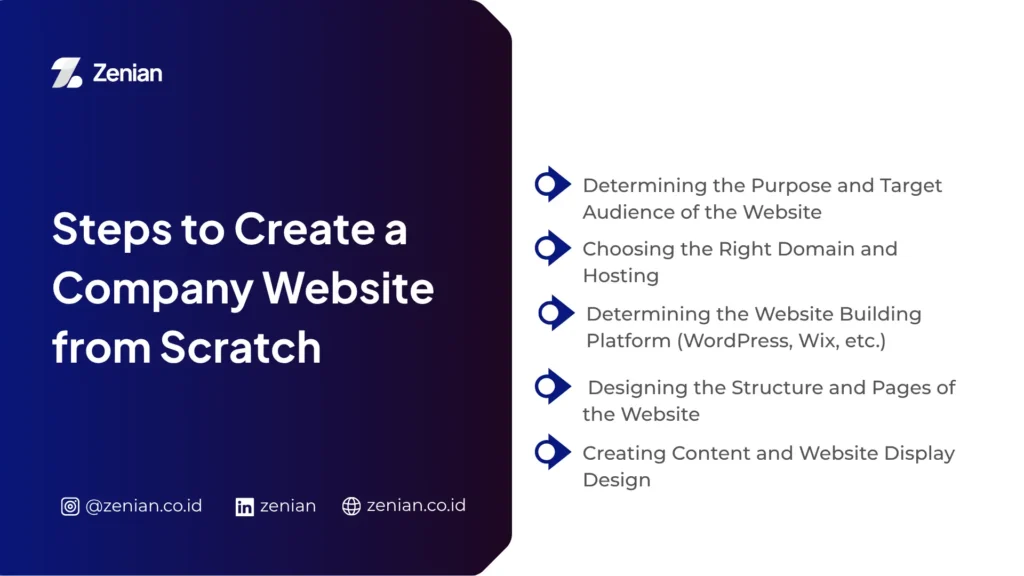
Steps to Create a Company Website from Scratch
Each stage plays an important role, from planning to launch. By following these steps, you can create a website that is not only visually appealing, but also functional and effective.
1. Determining the Purpose and Target Audience of the Website
This purpose will influence the entire direction of development, from design to the features used.
A website can be used to introduce brand identity, convey information about products or services, and build communication with potential customers.
In addition, a website also plays a role in increasing public trust and can even be used as a transaction platform through an e-commerce system.
2. Choosing the Right Domain and Hosting
A domain functions as a unique address that makes it easy for users to access the website, so it should be short, easy to remember, and reflect the business identity. Using extensions such as .com, .id, or .co.id can increase professionalism.
Meanwhile, hosting serves as the storage location for all website data. Choose a hosting service that is fast, stable, and secure, for example one that already uses Full SSD technology and is equipped with an SSL certificate.
3. Determining the Website Building Platform (WordPress, Wix, etc.)
The choice of platform must be adapted to needs and technical capabilities. WordPress is a popular choice because it is flexible and provides many themes and plugins, making it easy to create websites without having to master coding.
In addition, there are platforms like Wix that offer ease of use through a drag-and-drop system, and Shopify which is suitable for online store needs.
If you need very specific features, you can use custom development methods with technologies such as HTML, CSS, and JavaScript, although this option usually requires higher costs and expertise.
4. Designing the Structure and Pages of the Website
The website structure must be made simple and easy to understand so that visitors can find information quickly. Clear navigation will improve user comfort when browsing the website.
Some important pages that need to be provided include:
- Homepage as the main display and first impression
- About Us to explain the company profile and values
- Products/Services as an offering catalog
- Contact to facilitate communication
- Blog/Articles to support SEO strategy
- Testimonials/Portfolio as proof of credibility
5. Creating Content and Website Display Design
Content and design are the main factors that determine the attractiveness of a website. Use a responsive design so that the display remains optimal on various devices, from mobile phones to desktops.
In addition, ensure the use of colors and typography is consistent with the brand identity. The content presented must be clear, informative, and focused on benefits for users.
Add visual elements such as high-quality images or videos to enhance the visitor experience.
Don’t forget to include call-to-action buttons such as “Contact Us” or “Order Now” to encourage interaction and conversion.
6. Conducting Testing Before the Website is Launched
Before the website is published, conduct thorough testing to ensure all functions are working properly. Check every link, make sure pages load quickly, and there are no display errors.
Also optimize SEO aspects by setting meta tags, using relevant keywords, and compressing images so they don’t slow down loading. Make sure the SSL certificate is active to ensure the security of user data.
Once everything is ready, publish the website and promote it through various digital channels to reach a wider audience.
Read Too: 6 Ways to Create a Free Website on Google Sites for Beginners
How to Create an Attractive Company Profile Website
A company profile website serves as the digital face of the company that can be accessed at any time without time limits. To create an effective website, several main steps need to be carried out in a structured manner:
Mandatory Pages That Must Be on a Company Profile Website
So that the website can provide information maximally and convince visitors, the following pages must be available:
- Homepage (Home): Display a strong first impression and direct visitors to other important sections through clear navigation.
- About Us: Explain the company’s background, vision, mission, and values held to build closeness and trust.
- Products or Services: Present a complete product or service catalog with informative descriptions and high-quality visuals.
- Contact: Include important information such as phone number, email, office address, as well as social media links and a contact form.
- Testimonials and Portfolio: Display previous client experiences or project results to strengthen proof of credibility.
- Blog or Articles: Use as an SEO strategy to attract organic traffic while showcasing the company’s expertise.
- FAQ (Frequently Asked Questions): Provide answers to common questions so visitors can get information quickly without having to contact customer service.
Tips for a Professional Company Profile Website Design
A good website design must be able to combine aesthetics and user comfort (User Experience). The following tips can be applied:
- Responsive Design: Ensure the website display adapts to various devices, whether desktop, tablet, or smartphone.
- Simple Navigation: Arrange menus neatly so visitors can find information easily.
- Consistent Color Scheme: Use colors that match the brand identity to reinforce a professional impression.
- Clear Typography: Choose fonts that are easy to read with proportional sizes.
- Loading Speed: Optimize image sizes and use reliable hosting so the website is not slow.
- Clear Call-to-Action (CTA): Add buttons such as “Contact Us” or “Get a Quote” to encourage interaction.
- Guaranteed Security: Use an SSL certificate (HTTPS) to protect user data while increasing trust.
Examples of Good Company Profile Websites for Reference
Some of the following service providers can be used as references in structuring a professional website structure. For example, the Zenian website which displays a strong visual portfolio and an informative FAQ section for audiences.
By following the steps and strategies above and looking at examples, a company profile website can appear more professional, informative, and able to attract the attention of potential customers effectively.
Choosing the Right Website Development Service
Although many tools allow websites to be created independently, professional services are able to provide more optimal, structured, and secure results.
When Should You Use a Website Development Service?
Companies need to consider using professional services in the following conditions:
- Requiring high customization: The company needs special designs and features that cannot be fulfilled by standard templates, so custom development is needed.
- Limited technical resources: The internal team does not yet have expertise in coding, UI/UX design, or server management as a whole.
- Wanting to focus on the core business: The company wants to prioritize operations without having to handle technical aspects such as security updates, monitoring, and routine backups.
- Having an adequate budget: The company sees the website as a long-term investment and needs ongoing technical support from a professional team.
What to Consider When Choosing a Website Development Service
To avoid choosing the wrong vendor, pay attention to the following important aspects:
- Portfolio and clients: Review previous project results to assess design quality and experience in handling various industries.
- Technical expertise and security: Ensure the service provider understands SEO, responsive design, and implements security standards such as ISO 27001 certification.
- After-sales service: Choose a vendor that provides 24/7 technical support and routine maintenance services so the website remains optimal after launch.
- Service transparency: Ensure all features are explained in detail, including whether the service already covers domain, hosting, and SSL certificate.
Estimated Cost of Company Website Development Services
The cost of creating a company website varies depending on the needs and complexity of the project:
- Simple/beginner website: A basic company profile website can be created at a relatively affordable cost, even starting from below one million rupiah.
- Basic components: A domain generally starts from around Rp 15,000 per year, while hosting starts from Rp 50,000 per month.
- Custom development: A website built specifically using HTML/CSS/JS requires higher costs because it offers full flexibility.
- Managed services: Managed hosting services usually add costs, but provide convenience because all technical aspects are managed by a professional team.
Important Questions Before Hiring a Website Development Service
Before establishing a partnership, make sure the company asks the following questions to the vendor:
- Will the website be responsive on all devices?
- What SEO strategy is applied to the website structure?
- Will full access to the control panel (hosting/CMS) be provided?
- What security systems are used, such as SSL or automatic backup?
- What is the estimated time to complete the work until the website is ready to launch?
- Are there maintenance costs after the website is finished?
By considering all these aspects, companies can choose the right partner and ensure the website development process runs more effectively, safely, and in accordance with business needs.
Choose the Right Website Service for Maximum Results!
Choosing the right website development service is a strategic investment that determines the credibility and growth of your business in the digital era. A professional website is able to build trust and open up wider market opportunities.
With a directed approach, you will have a website that continues to work for your business. If you want to optimize your company website more maximally without hassle, considering the professional assistance of PT Zenian Digital Lab is appropriate to drive sustainable growth for your business.
Read Too: 5 Ways to Fix 404 Not Found: Meaning, Causes, and Solutions