

You may often wonder how many characters a meta description should have to remain effective in search results. In SEO practice, it’s important to understand that a meta description is a key element that influences user clicks.
Although it seems simple, the right description length can determine whether your content gets read or ignored. This article will discuss the ideal limits, the technical reasons behind them, and writing strategies to keep your message intact without being cut off across different devices.
What Is a Meta Description in SEO?
A meta description is a short text snippet that summarizes a webpage’s content and appears directly below the title in search results like Google. This element helps users understand the general idea of the content before they click.
Although there is no strict character limit, search engines typically display descriptions within a certain length and will truncate text that is too long to fit the user’s screen.
In practice, you usually write a meta description in the following HTML code:
<meta name="description" content="Your page description here">
Proper writing ensures that the information remains clear, concise, and not cut off when displayed.
Why Meta Descriptions Matter in SEO
Meta descriptions play an important role in SEO strategy because they directly influence user decisions. Here are their main functions:
- As a content preview: Helps users determine whether a page is relevant to their needs.
- Increase Click-Through Rate (CTR): Engaging and informative descriptions encourage users to click your page over others.
- Content promotion tool: Acts as a space to “sell” your content briefly but convincingly.
- Indirect ranking impact: While not a direct ranking factor, higher CTR can improve overall SEO performance.
- Help search engines understand content: Relevant descriptions make it easier for search engines to identify the main topic of a page.
What Is the Ideal Length of a Meta Description?
Most SEO practitioners recommend a length of 150–160 characters, as it is considered safe across devices. However, search engines actually measure display length in pixels, meaning each character has a different width and the visual length may vary.
Maximum Character Limit for Meta Descriptions
Search engines like Google do not enforce a strict character limit. However, if your description is too long, it will be automatically truncated. To stay safe, follow these guidelines:
- Safe maximum: around 160 characters
- Safer alternative: around 140 characters
- Recommended minimum: around 50 characters
Keeping your description within this range ensures your key message is fully delivered without being cut off.
Desktop vs Mobile Meta Description Length
Device differences also affect how descriptions appear:
- Desktop: ideally 155–160 characters
- Mobile: shorter, around 120–140 characters
Since mobile screens are smaller, previewing your description on both devices is highly recommended.
Impact of Overly Long Meta Descriptions
Writing descriptions beyond the ideal limit can cause several issues:
- Text gets cut off: Google adds ellipses (…) to long descriptions
- CTA becomes invisible: Calls-to-action at the end may not be seen
- Lower CTR: Incomplete snippets are less appealing
- Ineffective messaging: Key information may be lost
Functions of Meta Descriptions for SEO
Meta descriptions act as a bridge between your website content and potential visitors. Even though they are not a direct ranking factor, they significantly influence performance.
1. Increase Click-Through Rate (CTR)
A compelling, clear, and relevant description encourages users to click your page over others. It works like a short advertisement for your content.
2. Attract Attention on SERP
Meta descriptions serve as preview snippets on Search Engine Results Pages (SERPs). Adding a Call-to-Action (CTA) like “Learn More” or “Find Out Here” can increase clicks.
3. Support Content Relevance
They help reinforce content relevance by:
- Helping users understand the page before clicking
- Providing a concise summary of the topic
- Helping search engines identify the main subject
- Giving Google a better chance to display accurate snippets
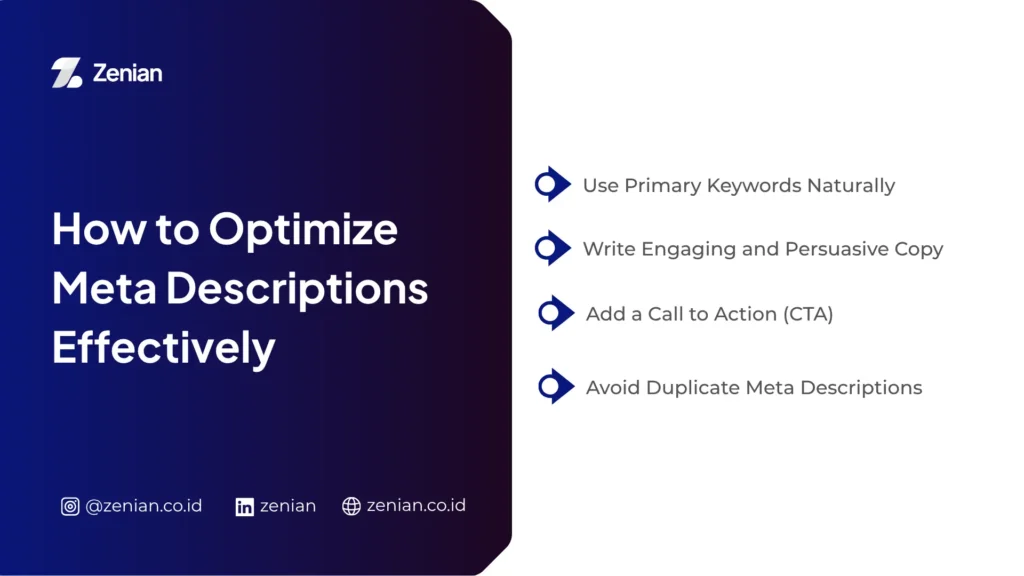
How to Optimize Meta Descriptions Effectively
1. Use Primary Keywords Naturally
Place your main keyword strategically, preferably at the beginning. Avoid keyword stuffing and keep the sentence natural.
2. Write Engaging and Persuasive Copy
Use simple, clear language that directly addresses user needs. Highlight benefits rather than just explaining content.
3. Add a Call to Action (CTA)
Use phrases like:
- “Learn More”
- “Click Here”
- “Discover Now”
This encourages users to take action.
4. Avoid Duplicate Meta Descriptions
Each page should have a unique description to prevent duplicate content issues and maintain SEO performance.
SEO Tips for Better Meta Descriptions
Match Search Intent
Align your description with what users are searching for to increase relevance and CTR.
Use Clear and Concise Language
- Be brief and to the point
- Avoid jargon
- Focus on benefits
- Make it engaging without overpromising
Optimize for Mobile Users
- Keep length around 120–140 characters
- Preview on both desktop and mobile
- Place keywords early for visibility
Common Meta Description Mistakes
Too Long or Too Short
Too long gets truncated; too short lacks clarity. Aim for at least 50 characters but stay within optimal limits.
Irrelevant to Content
Avoid clickbait. Misleading descriptions increase bounce rates and harm SEO.
No Keywords Included
While not a ranking factor, keywords improve visibility as search engines highlight them in results.
Maximize Your Website SEO with Zenian
Meta descriptions are crucial in determining whether users click your page. By following best practices, you can increase CTR and strengthen overall SEO performance.
However, managing a complete SEO strategy requires time and expertise. If you want optimal results without the hassle, consider working with PT Zenian Digital Lab as a trusted digital marketing partner to help grow your business potential effectively.