
Understanding what a lead is is essential for anyone looking to grow a business with a clear direction in the digital era. Many brands today do not just focus on finding immediate buyers; instead, they focus on building relationships with potential customers who are genuinely interested in their products or services.
Leads can help boost sales opportunities while expanding business reach effectively. Therefore, it is important to understand how the lead generation process works, what the benefits are, and the strategies you can implement.
What Is a Lead in Marketing?
A lead is a potential customer who has demonstrated interest in the products or services offered by a business.
This interest is typically shown when someone takes a specific action, such as filling out a form, downloading an e-book, registering for a webinar, or providing their email address and phone number through a business website.
Businesses leverage leads to increase sales opportunities because they are not just random visitors. Leads hold a higher potential to convert into active customers compared to an audience that merely views content without interacting.
What Is Lead Generation?
Lead generation is the process of attracting, gathering, and identifying potential customers so that a business can acquire high-quality leads. This strategy helps companies build a database of potential buyers who can later be guided through the purchasing process.
Differences Between Lead Generation and Sales
While both are related to revenue, lead generation and sales have different areas of focus within the business process:
- Lead Generation: Operates at the early stages to grab the audience’s attention and build interest in a product or service. This strategy generally uses a one-to-many approach through content, advertisements, social media, or other digital campaigns.
- Sales: Focuses on the final stages to convert potential customers into buyers. The sales team engages in more personalized communication, such as product presentations, price negotiations, service demonstrations, or direct partnership offers.
Other distinctions can be seen in their primary goals and data management:
- Primary Goals: Lead generation aims to build initial relationships and identify potential market opportunities. Conversely, sales focuses on the closing process to ensure transactions actually happen.
- Data Management: The lead generation team typically gathers data on prospects who still need to be nurtured through the pipeline, while the sales team handles leads who are ready to buy and have already passed the qualification stage.
Functions of Leads in Marketing
Leads help businesses identify potential customers who have already shown interest in specific products or services. Aside from helping boost revenue, leads also make it easier for businesses to determine more effective and targeted marketing strategies.
1. Helps Increase Sales Opportunities
Leads offer a massive opportunity for businesses to increase sales because these prospective customers have shown interest from the start. This condition makes the likelihood of conversion much higher compared to a generic audience.
Businesses can also prioritize specific types of leads to speed up the sales process, such as:
- Sales Qualified Leads (SQL): Potential customers who are ready to be contacted directly by the sales team.
- Product Qualified Leads (PQL): Users who have already experienced the product through a demo or a free trial.
By focusing on high-potential leads, marketing and sales teams can work more efficiently to achieve sales targets.
2. Eases Targeting the Right Audience
Data gathered from leads helps companies understand the needs, interests, and behaviors of prospective customers more accurately. This information makes it easier for businesses to define the right target market, making marketing strategies far more effective.
Companies can utilize this data to:
- Send relevant offers to the right audience.
- Reduce wasted promotional costs on low-potential targets.
- Tailor communication styles based on the prospect’s readiness to buy.
A more personalized approach also helps businesses build closer relationships with potential consumers.
3. Supports More Effective Marketing Strategies
Analyzing leads helps companies understand market trends and ever-changing consumer needs. From this data, businesses can determine more relevant strategies to improve product or service quality.
Furthermore, companies can execute strategies like content marketing and email marketing on a more personal level. Content tailored to the audience’s needs is generally more successful at capturing attention and boosting long-term customer loyalty.
4. Helps Measure Marketing Campaign Performance
Leads also serve as an indicator of a marketing campaign’s success. Through lead data, companies can evaluate whether the deployed marketing strategy is genuinely successful in attracting a quality audience.
Some elements that can be evaluated through leads include:
- The effectiveness of a campaign in generating potential prospects.
- The performance of the marketing channels used.
- The quality of traffic coming into the website or landing page.
Many companies utilize Customer Relationship Management (CRM) systems to monitor this data so that evaluation and optimization processes can be conducted continuously.
5. Increases Business Conversion Rates
Structured lead management can help businesses increase their conversion rates significantly. Through the lead management process, companies can prioritize prospects who have the highest probability of making a purchase.
Today, many businesses use CRM software integrated with AI technology for lead scoring. This system helps teams determine which leads to prioritize based on their conversion potential.
Additionally, the nurturing process helps build relationships with potential customers gradually until they are ready to buy. Strategies like offering a free trial are often highly effective at driving conversions because prospects can experience the product’s benefits firsthand.
Read Too: 4 Types of Digital Marketing? Comprehensive Guide and Examples
Types of Leads in Marketing
Every lead has different characteristics. Some prospective customers are just looking for information, while others are ready to make a transaction. Therefore, businesses must recognize where a prospect stands in the buying process.
1. Marketing Qualified Lead (MQL)
A Marketing Qualified Lead (MQL) is a prospective customer who has started showing interest in a product or service through various marketing activities. Usually, they interact with the content created by the company to gather additional information.
Examples of MQL activities include:
- Filling out a form on a landing page.
- Downloading an e-book or whitepaper.
- Subscribing to a newsletter.
- Attending a webinar or an online event.
MQLs are generally still in the early stages of the buying journey. They are interested, but not yet ready to be contacted directly by the sales team. Therefore, companies need to provide additional education through relevant content to further develop their interest.
2. Sales Qualified Lead (SQL)
A Sales Qualified Lead (SQL) is a lead that has passed the filtering process by the marketing team and is deemed to have high potential to purchase the product or service.
Prospective customers in this category usually exhibit more serious actions, such as:
- Requesting a product demo.
- Contacting the sales team directly.
- Inquiring about detailed pricing.
- Requesting a business proposal.
SQLs have a much higher conversion probability than MQLs. Consequently, the sales team needs to make a proactive approach immediately to expedite the transaction process.
3. Product Qualified Lead (PQL)
A Product Qualified Lead (PQL) refers to individuals who have already used the company’s product—typically through a free trial or a free version (freemium)—and have shown intent or interest in upgrading to the paid version.
This type of lead has immense potential because the prospect has experienced the value of the product firsthand. Signs of a PQL include:
- Actively using core features.
- Frequently accessing the product during the trial period.
- Reaching the usage limits of the free version.
- Providing positive feedback regarding the service.
Because they already understand how the product works, the chances of a PQL turning into a paying customer are usually greater than any other type of lead.
4. Cold, Warm, and Hot Leads
Aside from qualification stages, companies also categorize leads based on their level of interest and readiness to buy.
- Cold Lead: Prospects who have only shown initial interest. They might just be looking for quick info or are simply curious about the product. At this stage, the business usually only has their contact data. Since interest is low, businesses need to build communication slowly through education and relevant content.
- Warm Lead: Prospects who have actively started interacting with the business. They regularly read content, attend webinars, or open promotional emails. The position of a Warm Lead is similar to an MQL concept because they have moved deeper into the sales funnel but still need time before making a buying decision.
- Hot Lead: Prospects who have shown a clear intention to buy. They are typically ready to make a transaction or want to be contacted by the sales team immediately. This category aligns with SQLs or PQLs because the prospects understand their needs and feel the offered product is the right fit.
5. Service Qualified Lead
In addition to the types above, there is also the Service Qualified Lead. This type of lead comes from existing customers who want to upgrade their current service or add a new package.
For instance, a customer might contact customer support to upgrade features or increase their service capacity. This situation opens up massive opportunities for companies to upsell and increase business revenue.
How to Generate High-Quality Leads
Acquiring high-quality leads requires the right strategies to ensure businesses can reach prospective customers who are genuinely interested in the products or services offered.
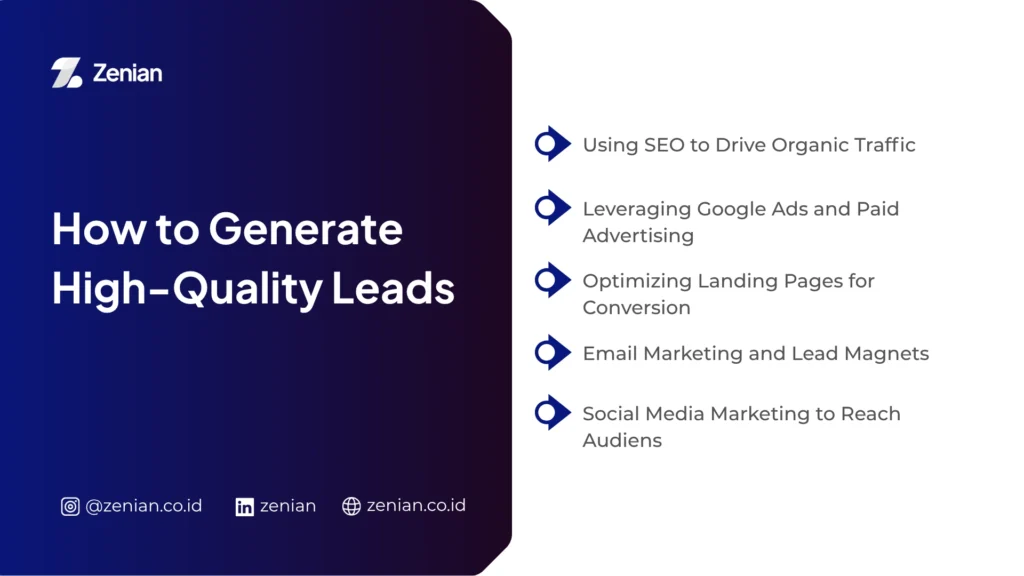
1. Using SEO to Drive Organic Traffic
Search Engine Optimization (SEO) strategies help a website appear more easily on Google search results. When audiences look for solutions or information related to a business, an optimized website stands a much higher chance of being visited.
The optimization process includes keyword research, creating compelling titles, writing meta descriptions, and managing internal and external links. Additionally, on-page and off-page optimization help boost website credibility in the eyes of search engines.
Organic traffic from search engines generally yields high quality because visitors arrive with specific needs or interests. This makes the chance of conversion much higher compared to random visitors.
2. Leveraging Google Ads and Paid Advertising
Paid advertising helps businesses reach audiences more quickly and measurably. Today, many ad platforms can be utilized, such as Google Ads, Meta Ads, TikTok Ads, and LinkedIn Ads.
To optimize ad performance, businesses need to create promotional materials that are attractive and relevant to the audience’s needs. The right ad content can drive potential customers to click on the offer page and fill out their contact data.
Audience targeting is also a critical factor in paid advertising. By utilizing ad targeting features, businesses can define targets based on age, location, interests, and user behavior so that the promotional budget is spent efficiently.
3. Optimizing Landing Pages for Conversion
Landing pages play a vital role in turning visitors into leads. This page must be capable of providing clear information while driving the audience to take a specific action.
Key elements to consider in landing page optimization include:
- Use Clear Calls to Action (CTA): Phrases like “Try for Free”, “Register Now”, or “Download Now” help guide visitors to take action.
- Keep Forms Simple: Forms that are too long often deter audiences from filling out their data. Therefore, keep forms short and easy to understand.
- Display a Professional Design: A clean, organized, and informative page layout can boost visitor trust in your business.
Additionally, ensure the page loads quickly on both desktop and mobile devices so the user experience remains seamless.
4. Email Marketing and Lead Magnets
Email marketing remains an effective strategy for maintaining relationships with potential customers. Through this method, businesses can send information, promos, and educational content directly to the audience.
To capture the attention of prospects, companies usually offer a lead magnet in the form of an e-book, newsletter, free webinar, or whitepaper. Interested audiences will exchange their contact data as a requirement to get the offer.
Once the data is collected, businesses can send more personalized and relevant content tailored to the audience’s needs. This strategy helps foster a closer relationship with prospects until they are ready to purchase.
5. Social Media Marketing to Reach Audiens
Social media is an effective channel for building interactions with potential customers. Engaging content can help businesses expand their reach while increasing brand awareness.
To optimize social media strategies, keep these factors in mind:
- Build Active Interaction: Replying to comments and messages quickly can increase a prospect’s trust in your business.
- Choose the Right Platform: Instagram and Facebook are great for reaching a broad consumer market, while LinkedIn is far more effective for B2B (business-to-business) needs.
- Create Relevant and Consistent Content: Consistent educational, entertaining, and promotional content helps maintain long-term audience engagement.
How to Check Website Rankings to Support Lead Generation
Checking website rankings helps businesses understand how effective their executed SEO strategies are. Therefore, business owners need to monitor website performance regularly.
1. Why Do Website Rankings Affect Leads?
A website’s position on search engines heavily dictates digital marketing success. The higher a page ranks, the more likely prospects are to visit it. Here is why website rankings are crucial for supporting leads:
- The website is found more easily by prospects searching for information on Google.
- Incoming traffic tends to be highly relevant because it stems from keywords matching the audience’s needs.
- Conversion opportunities increase as visitors easily find the products, services, or forms available.
- The business can reach more potential consumers organically without constantly relying on paid ads.
Because of this, many businesses have shifted focus toward optimizing their websites to compete on the first page of search results.
2. How to Check Website Rankings on Google
The simplest way is to type target keywords directly into Google. Use incognito mode so search results are not influenced by your previous browsing history. After that, observe your website’s position in the search results.
While this method is helpful for a quick check, results may not always be 100% accurate because rankings can vary depending on the user’s location and device.
Alternatively, businesses can use analytics platforms to monitor website positions automatically. These tools typically display ranking data, clicks, impressions, and keyword performance over a specific period. With this data, business owners can determine more precise optimization strategies to increase lead opportunities.
3. Tools to Check Website Rankings
Various SEO tools can help monitor website performance more practically and in-depth. Here are some of the most common tools used in the digital marketing industry:
- a. Google Search Console: A free service from Google that helps website owners monitor site performance in search results. This tool displays keyword data, clicks, impressions, and the average position of pages on Google. It also helps detect technical issues that might hurt SEO performance.
- b. Ahrefs: A highly popular SEO tool widely used for competitor analysis and website ranking tracking. This platform displays detailed keyword position changes, making it easy to evaluate SEO strategies. It also provides comprehensive backlink analysis and keyword research features.
- c. SEMrush: Helps businesses monitor website rankings through its position tracking feature. This tool allows users to see keyword positions based on geographic location and the device used, which is highly beneficial for understanding audience behavior.
- d. Ubersuggest: Offers a simpler interface, making it ideal for beginners and small business owners. This tool helps track keyword performance, find content ideas, and monitor website ranking progress periodically without overly complex processes.
How to Improve Website Rankings to Increase Leads
When a website appears on the right search pages, prospects can find the offered products or services effortlessly. Therefore, website optimization strategies must be carried out consistently so traffic and conversion opportunities keep growing.
5 Critical Factors That Heavily Influence Rankings:
- Implement On-Page and Off-Page SEO
- Conduct Proper Keyword Research
- Optimize Titles and Meta Descriptions
- Create Quality Content Consistently
- Improve Website Speed and Design
Common Mistakes in Lead Generation Strategies
Many businesses spend massive marketing budgets, yet their lead generation results remain subpar. To make the process of acquiring potential customers more effective, avoid the following mistakes:
1. Targeting the Wrong Audience
Targeting an audience that is too broad often results in low-quality leads. While a website might get plenty of visitors, not all of them possess a genuine interest in buying the offered product or service.
Businesses need to understand market trends and customer preferences more specifically. Proper audience segmentation helps marketing strategies reach people who actually need the solutions provided.
2. Failing to Optimize the Website for Conversions
Many websites focus too much on driving traffic without paying attention to the visitor’s experience once they land on the page. A website that is not optimized for conversions will struggle to yield quality leads.
Common conversion mistakes include:
- Not providing a clear Call to Action (CTA), leaving visitors confused about the next step.
- Using landing pages that are unappealing or irrelevant to the audience’s needs.
- Creating registration forms that are too long, deterring visitors from filling them out.
Every element within a website must be designed to guide visitors toward taking a specific action, whether it is registering, contacting the business, or completing a purchase.
3. Ignoring SEO and Website Rankings
Relying solely on paid ads continuously without paying attention to SEO can be a detrimental long-term mistake. When the ad budget stops, website traffic usually drops drastically.
SEO optimization helps a website stay visible on search engines organically, ensuring opportunities to attract potential customers remain wide open. A website that is easy to find has a much higher potential to attract quality leads than a site that struggles to rank.
4. Neglecting to Follow Up on Leads
Acquiring a prospect’s contact data is not the final step of a marketing strategy. Following up quickly and relevantly is vital so conversion opportunities are not lost.
Frequent mistakes in this process include:
- Responding too slowly, causing potential customers to lose interest.
- Sending generic, unpersonalized communication that fails to address the audience’s needs.
- Managing data manually without the help of a structured system.
To overcome these issues, using CRM software can make the lead management process significantly more efficient. This system allows businesses to automate follow-ups while prioritizing prospects with the highest conversion potential.
Grow Your Business Leads with Zenian Digital Marketing
Increasing the number of high-quality leads requires the right digital strategy. As a results-driven digital partner, PT Zenian Digital Lab (Zenian Digital Marketing) is ready to help your business build marketing strategies that are more effective, measurable, and sustainable.
We deploy tailored strategies aligned with your business needs to ensure your digital performance grows to its maximum potential. If you want to boost your website’s performance and acquire high-quality leads consistently, contact the Zenian team today!
Read Too: 4 Types of Digital Marketing? Comprehensive Guide and Examples