

Amid increasingly intense digital competition, appearing on the first page of Google is no longer just a desire—it’s a necessity. Almost every consumer decision today starts with a search engine, whether it’s to find products, services, or simply compare brands. At this point, SEO and SEM often become the two most frequently discussed strategies.
The problem is, many businesses still assume that SEO and SEM are the same thing. In reality, even though both operate within search engines, their mechanisms, costs, and business impacts are very different. Choosing the wrong strategy can drain your budget without delivering optimal results.
This article will discuss the differences between SEO and SEM in depth, from how they appear in search results and their long-term effects to their cost implications. So before you decide on a digital marketing strategy, make sure you truly understand which one is most relevant for your business.
What Is SEO?
SEO (Search Engine Optimization) is a strategy to optimize a website so it appears organically in search engine results such as Google. This means a website can gain traffic without paying for ads per click. The main focus of SEO is content quality, website structure, and user experience.
In practice, SEO covers many aspects, ranging from keyword research and on-page optimization such as titles and meta descriptions, to off-page efforts like backlinks. Google itself evaluates websites based on relevance, credibility, and user experience before placing them at a certain ranking.
SEO usually does not deliver instant results. However, once it becomes stable, SEO can turn into a long-term asset that consistently brings in high-quality traffic and increases brand trust in the eyes of potential customers.
What Is SEM?
SEM (Search Engine Marketing) is a search engine marketing strategy that is paid, generally through platforms like Google Ads. With SEM, a website can instantly appear at the top of search results with the label “Ad.”
The main advantage of SEM lies in its speed. Within hours, ads can go live and reach specific target audiences based on keywords, location, and even user behavior. This makes SEM highly effective for short-term campaigns or promotions that require fast results.
However, SEM is heavily dependent on budget. When the ads are stopped, traffic stops immediately as well. Therefore, SEM is more suitable as an accelerator rather than a standalone long-term strategy.
Differences Between SEO and SEM
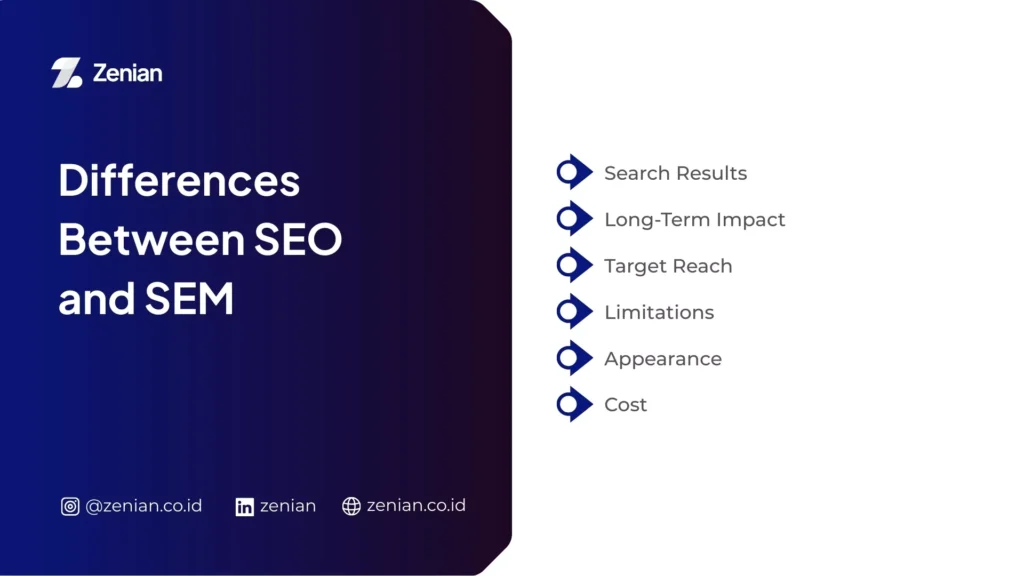
Although both aim to increase visibility in search engines, SEO and SEM have very different approaches, costs, and impacts on businesses. Understanding these differences is a crucial step before determining the most effective digital strategy.
1. Search Results
SEO places websites in organic search results, usually below ads. These positions are achieved through optimization processes and Google’s algorithmic evaluation of website quality.
SEM displays websites at the very top of search result pages with an ad label. This position is not determined solely by content quality, but also by keyword bidding systems and ad quality scores.
From a user perception perspective, organic results are often seen as more credible, while ads excel in instant visibility.
2. Long-Term Impact
SEO excels in the long term. Well-optimized content can generate traffic for months or even years without additional cost per click.
SEM is short-term in nature. As long as the budget is active, traffic will continue to flow. But once the ads are turned off, visibility immediately drops to zero.
That’s why many businesses combine both: SEM for quick results, SEO for long-term foundations.
3. Target Reach
SEO reaches users who actively search for information organically. This audience is usually in the awareness to consideration stage and tends to place more trust in informative content.
SEM allows much more specific targeting, ranging from transactional keywords and geographic locations to ad schedules and device types. This makes it ideal for driving conversions quickly.
These differences make SEO stronger for market education, while SEM is more aggressive in driving sales.
4. Limitations
SEO is limited by constantly changing search engine algorithms. Results cannot be fully controlled and require time and consistency.
SEM is limited by budget and keyword competition. The more competitive the keyword, the higher the cost per click.
Both come with risks, but with the right approach, those risks can be managed.
5. Appearance
SEO results appear as standard listings without ad labels, complete with page titles, URLs, and meta descriptions. This creates a natural and informative impression.
SEM appears with an “Ad” label and often includes additional extensions such as call buttons, sitelinks, or promotions. Visually, ads are more eye-catching.
These display differences influence click-through rates (CTR), depending on the user’s search intent.
6. Cost
SEO does not require a cost per click, but it does require investment in time, effort, and content production or technical optimization.
SEM uses a pay-per-click (PPC) system, meaning every click has a cost. Budget must be continuously allocated to keep ads running.
In general, SEO is more cost-efficient in the long run, while SEM is more flexible for fast-paced campaigns.
Looking for an SEO & SEM Implementation Partner?
Understanding the differences between SEO and SEM alone is not enough without proper execution. Effective strategies are born from combining both approaches, tailored to business goals, market conditions, and website readiness.
SEO builds a long-term foundation, while SEM accelerates results. When both work in harmony, a brand doesn’t just become visible—it becomes relevant and competitive in search engines.
If you want a measurable, data-driven SEO and SEM strategy that truly supports business growth, working with a partner who understands your business context is a smart move.
If you need a partner who understands long-term SEO as well as data-driven SEM execution, PT Zenian Digital Lab is ready to help design and implement a digital strategy focused on growth, not just traffic.