Many business owners still do not fully understand what a Call to Action is, and why this button is often considered a benchmark for marketing campaign success. In reality, without clear direction, audiences may simply leave a page without taking any action at all.
Because of this, many brands leverage CTAs to guide visitors toward the next step, ranging from reading further information to making a purchase. Ultimately, a CTA serves as a vital tool to increase interaction, generate leads, and drive conversions.
What Is a Call to Action?
A Call to Action (CTA) is an invitation or prompt that encourages an audience to take a specific action after viewing, reading, or interacting with a piece of content. A CTA acts as a signpost that helps prospective customers determine their next step.
Business owners typically display CTAs in the form of short phrases, buttons, or easily discoverable hyperlinks. They are placed in strategic positions and use eye-catching designs to quickly capture a visitor’s attention.
Functions of a CTA in Marketing
Beyond being a simple prompt, a CTA helps businesses guide their audience toward actions that generate real value. Here are several critical functions of a CTA within a marketing strategy:
1. Driving Audience Action
A CTA helps the audience make decisions faster. When someone finishes reading an article, viewing an ad, or visiting a product page, the CTA provides clear direction on what to do next.
Through simple phrases like “Sign Up Now”, “Learn More”, or “Contact Us”, businesses can direct visitors to engage further. This clear guidance eliminates guesswork for the audience.
2. Boosting Leads and Conversions
One of the primary goals of using a CTA is to increase the volume of leads and conversions. A CTA helps businesses convert regular visitors into prospective customers who have the potential to make a transaction.
Some key benefits include:
Collecting prospect data through registration forms or newsletter subscriptions.
Encouraging visitors to request a product demo or consultation.
Directing potential customers to a purchase page, thereby increasing sales opportunities.
The more relevant and compelling the CTA, the higher the likelihood that the audience will take the desired action.
3. Guiding the Customer Journey
In the marketing process, customers usually go through several stages before finally making a purchase. A CTA helps guide this journey so that it flows in a more structured manner.
For example, a visitor who is completely new to a brand can be directed to read a related article first. Once interested, they can be guided to download a guide, sign up for a consultation, or proceed directly to a transaction.
4. Supporting Sales and Marketing Strategies
A CTA also functions as an evaluation tool that helps businesses measure the effectiveness of a marketing campaign. By tracking the number of clicks received, marketing teams can determine whether the message delivered successfully captured the audience’s attention.
In other words, a CTA not only drives action but also provides crucial data that supports decision-making in sales and marketing activities.
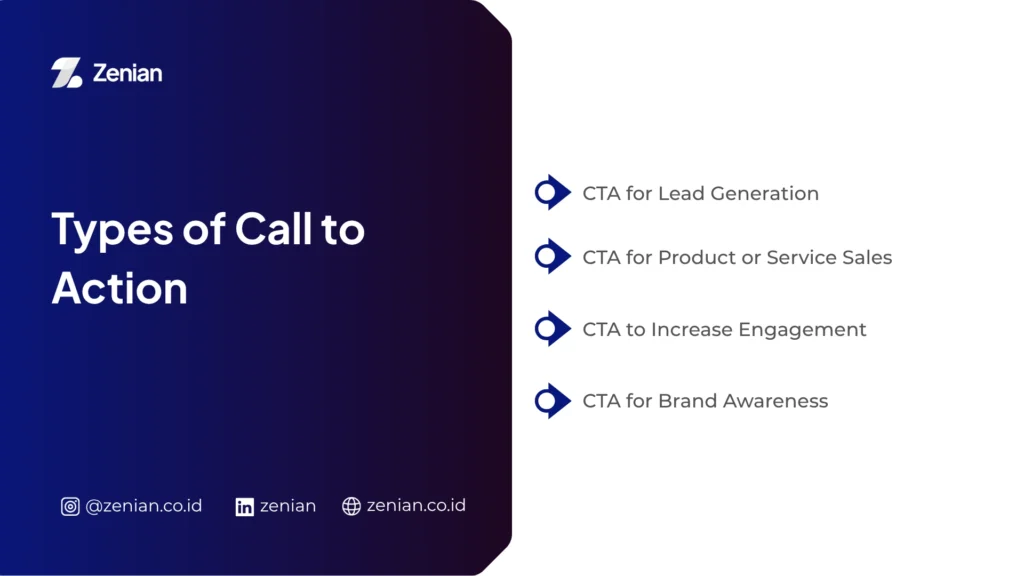
Each call to action serves a different purpose within a marketing strategy. Here are some of the most frequently used types of CTAs in marketing activities:
1. CTA for Lead Generation
This type of CTA helps businesses collect contact information from prospective customers who show interest in a product or service. Typically, these CTAs are placed on blog pages, landing pages, or floating banners that experience high traffic volumes.
This method makes it easier for companies to convert casual visitors into high-potential prospects.
Examples of Lead Gen CTAs:Sign Up Now, Request a Demo, Subscribe to Newsletter, Download Free Guide.
2. CTA for Product or Service Sales
Sales CTAs focus on driving actions that directly result in a transaction. This type of CTA usually appears on product pages, checkout pages, or special promotions offering specific benefits to the customer.
Sales CTAs often use language that creates a sense of urgency, prompting the audience to make an immediate decision. Additionally, businesses frequently add attractive offers—such as discounts or bonuses—to boost conversion rates.
3. CTA to Increase Engagement
Not all CTAs aim to generate immediate sales. Many businesses use CTAs to encourage the audience to interact with the content they publish. This interaction can take the form of comments, shares, or following social media accounts.
The higher the audience engagement rate, the greater the opportunity for the content to reach more people organically. Aside from boosting visibility, this strategy helps businesses build closer relationships with their community and customers.
4. CTA for Brand Awareness
CTAs for brand awareness aim to introduce a brand to audiences who are not yet familiar with the business. The main focus here is not direct sales, but rather building interest and deepening the audience’s understanding of the products, services, or values offered by the company.
This type of CTA is frequently used in educational articles, promotional campaigns, and event publications. By providing relevant information, businesses can capture the attention of prospective customers before guiding them to the next stage of the buying process.
An effective CTA generally shares one common trait: it uses clear verbs that directly command the audience to act. Here are several examples and their breakdowns:
1. CTA Examples on Websites
Websites require CTAs that function as signposts so visitors can find the information they need with greater ease. Common examples include:
“Learn More”
“View Product Demo”
“Discover More”
“Read More”
Aside from buttons, elements like search bars and “back to top” icons can also function as CTAs because they help visitors navigate and interact with the website more comfortably.
2. CTA Examples on Landing Pages
A landing page usually focuses on one primary goal, such as collecting prospect data or driving service registrations. Therefore, the CTA on this page must stand out clearly and be easy to find.
“Register Now”
“Request a Demo”
“Start Consultation Now”
“Submit”
“Get a Free Trial”
“Book a Call”
These CTAs help prospective customers take the next step without feeling confused or hesitant.
3. CTA Examples on Social Media
Social media relies heavily on interaction to expand reach and build relationships with the audience. Because of this, CTAs on these platforms usually invite users to respond immediately.
“Share This Post”
“Leave a Comment”
“Tag Your Friends”
“Follow Us on Instagram”
“Follow Us on Social Media”
Many brands also utilize QR Codes on outdoor advertising to direct audiences to their social media accounts, promotional pages, or official websites with a single scan.
4. CTA Examples in Email Marketing
In email marketing strategies, a CTA helps maintain customer relationships while prompting them to take a specific action. A relevant CTA can significantly boost the click-through and engagement rates of email recipients.
“Subscribe to Our Newsletter for Exclusive Offers”
“Get the Latest Updates”
“Join Our Community”
“Sign Up Now for Premium Access”
5. CTA Examples for E-commerce
E-commerce businesses frequently use more direct and assertive CTAs because their ultimate goal is to drive immediate transactions. These CTAs usually highlight benefits, promotions, or the ease of the purchase process.
“Buy Now”
“Buy Now and Get 20% Off”
“Get the Discount Today”
“Add to Cart”
“Checkout Now”
“Leave a Review”
“Give Your Feedback”
5 Ways to Create Compelling and Effective CTAs
An effective CTA helps users understand their next step effortlessly. Therefore, it is crucial to pay attention to word choice, placement, and testing strategies so that your CTA can generate optimal conversions.
1. Use Clear and Concise Language
Audiences usually make decisions in a matter of seconds. Because of this, keep your CTA phrases short, easy to understand, and directly focused on a specific action.
For instance, instead of using a generic phrase like “Click Here”, use a more specific CTA such as “Get the Free Ebook” or “Start Free Trial”. Phrases like these give the audience a clearer picture of the value they will receive.
2. Create a Sense of Urgency
A sense of urgency can prompt the audience to make decisions faster. This strategy is frequently used to reduce hesitation while boosting conversions within a short timeframe.
You can add words like “Now”, “Today”, or “Immediately” to create the impression that the opportunity will not last forever. Time-limited offers are highly effective at increasing the audience’s motivation to act. However, ensure that the created urgency remains genuine and not overdone, so that the audience maintains trust in your brand.
3. Tailor the CTA to the Target Audience
If the audience is still in the information-seeking phase, use a soft CTA like “Learn More”, “Read More”, or “View Complete Guide”.
Conversely, if the audience has already shown an intent to buy, use a hard CTA like “Checkout Now”, “Order Today”, or “Start Subscription”.
Additionally, align the CTA with your business goals. If the primary focus is collecting prospect data, use a CTA that directs visitors to fill out a form or sign up for a newsletter.
4. Position the CTA Strategically
Ensure the CTA appears in highly visible areas, such as above the fold (the top part of the page), in the middle of the content when the topic is most engaging, or at the end of the article after the audience has received the information they need.
Beyond positioning, design plays a massive role in boosting CTA visibility. Use a color that contrasts with the background, an easily readable font size, and a prominent button design that stands out without disrupting the user experience.
On a blog post, CTAs are commonly placed in the following locations:
The end of the article
The sidebar
Floating banners
The middle of the content
Tim-triggered pop-ups
5. Run A/B Testing for Your CTAs
There is no single CTA formula that works universally for every business. Therefore, conduct regular A/B testing to discover which CTA version yields the best results.
By consistently performing A/B tests, a business can continuously improve CTA performance, lower customer acquisition costs, and achieve a better return on investment (ROI).
Boost Your Business Conversion with Zenian
A well-crafted CTA can boost conversions, generate more leads, and create a superior user experience. Consequently, every business must ensure that the CTAs they deploy are capable of successfully driving audience action.
If you want to optimize your CTAs and build a digital strategy that delivers tangible results, PT Zenian Digital Lab is ready to be your partner. Backed by experience handling thousands of leads from various clients, our team is equipped to help you turn traffic into real business opportunities.