

You may not be used to relying on search tools besides Google, because Google is indeed top of mind when we want to find information quickly, but the internet world actually offers many more interesting options.
Each platform has a different way of displaying results on the SERP, ranging from privacy focus to community-based search. This article will discuss various search engines besides Google for a more relevant data browsing experience.
What Are Search Tools Besides Google?
Search tools besides Google are search engine platforms that help you find information on the internet through different approaches, technologies, and algorithms.
Each search engine presents a unique browsing experience, from privacy protection to more specific content delivery according to user needs.
The dominance of one platform for years has not stopped innovation in the digital search world. Many developers present alternatives with certain focuses, such as data security, neutral search results, or category-based search.
Why Use Search Engines Besides Google?
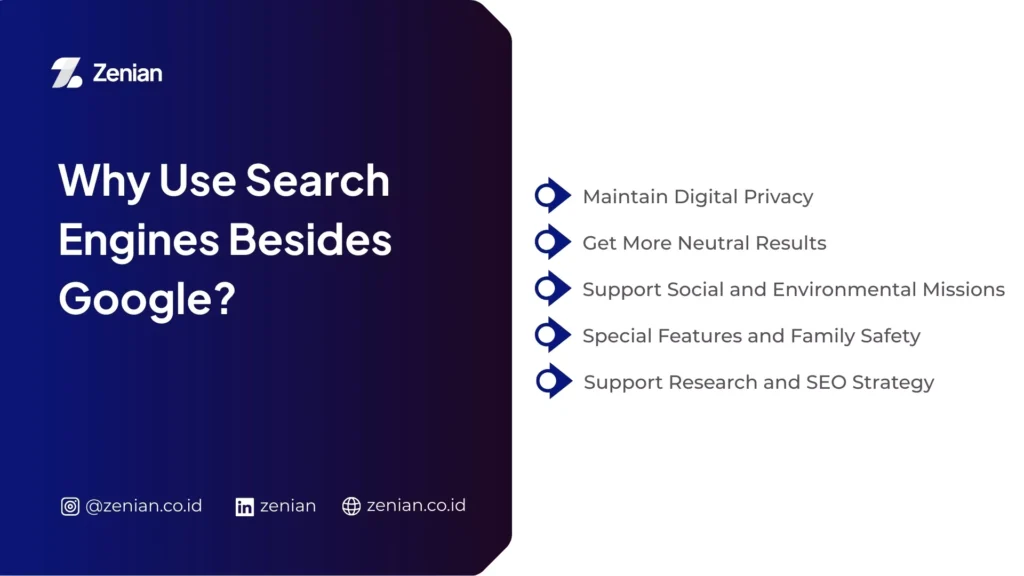
Using alternative search engines helps you get a more balanced, secure, and perspective-rich browsing experience. Each platform brings added value that is not always found in just one search engine.
1. Maintain Digital Privacy
Some users are now more aware of data security. Much information related to security has already raised user awareness.
Therefore, many platforms prioritize anonymity by not creating ad profiles or tracking search history. This approach helps reduce the risk of digital surveillance.
2. Get More Neutral Results
Personalization algorithms often create a filter bubble, which is a condition where search results adjust to the user’s previous preferences.
Alternative search engines present a variety of perspectives so you can see more objective and broader information.
3. Support Social and Environmental Missions
Some platforms combine technology with real social impact. Some use ad revenue to plant trees in various countries.
There are also platforms that channel profits to provide global clean water. This benefits both users and the environment.
4. Special Features and Family Safety
User needs are not always the same. Some platforms automatically filter explicit content so they are safe for children.
On the other hand, some provide answers based on logical calculations, scientific data, and mathematical analysis that greatly help academic and professional activities.
5. Support Research and SEO Strategy
Using multiple search engines at once helps professionals understand variations in global algorithms.
This approach facilitates competitor analysis, international trend exploration, and the development of more comprehensive keyword research strategies.
Read Too: 8 Benefits of SEO for Businesses in the Digital Era
Popular and Worth-Trying Search Tools Besides Google
Google does dominate the internet search world. However, various search tools besides Google continue to develop by offering different advantages. Here is the list:
1. DuckDuckGo
DuckDuckGo is a popular choice for users who want to maintain online activity security. This platform focuses on privacy protection without sacrificing search result quality.
DuckDuckGo runs the principle of Privacy, Simplified by not tracking user search activity. Its system does not store personal data or create user profiles for digital advertising needs.
Because it does not apply tracking-based personalization, DuckDuckGo displays more objective information without the filter bubble effect. The results that appear tend to be neutral and not influenced by previous search history.
2. Bing
Bing is a search engine developed by Microsoft and is one of Google’s strong competitors. This platform presents modern technology integrated with various popular digital services.
Bing is directly connected with products such as Office, Windows, OneDrive, and Xbox. This integration makes it easier for users already within the Microsoft ecosystem to work and search for information more efficiently.
3. Yahoo Search
Users can directly access various services such as Yahoo Mail, News, Finance, and Sports without needing to switch sites. This integration makes Yahoo not just a search engine but a daily information hub.
Through Yahoo! Answers, users can find solutions from community experiences. Interaction between users helps provide more practical answers based on real experiences.
4. Startpage
Startpage offers an ideal solution for users who like Google-quality search results but still want to maintain digital privacy.
Startpage displays high-quality search results without collecting personal data or recording user activity. This system enables a safe information-searching experience.
5. Ecosia
Ecosia presents a search engine concept with a strong social and environmental mission. This platform allocates around 80% of its ad revenue to fund tree-planting programs in various countries as a real effort against climate change.
Users not only search for information but also contribute to preserving the earth every time they perform a search. Ecosia openly displays financial reports and the number of trees planted, making transparency its main value.
6. Brave Search
Brave Search was developed by the team behind Brave Browser with the main focus on user privacy protection. This search engine uses its own independent search index so it does not depend on data from other search engines.
This platform delivers a clean browsing experience without invasive ads and does not track user activity for ad profiling needs. Privacy, speed, and a simple interface are the main combination offered by this service.
7. Qwant
Qwant comes from Paris, France, and is designed to follow very strict European privacy regulations. This search engine tries to avoid the filter bubble phenomenon, where users only receive information that matches previous search habits.
To produce more diverse search results, Qwant combines its own web index with data from Bing. Besides a modern interface, this platform provides special categories such as news, music, and a safe search version for children.
8. Swisscows
Swisscows is based in Switzerland and is known as a search engine that prioritizes family safety. Its system automatically filters violent and pornographic content, making it safe for children, schools, and work environments.
This platform uses artificial intelligence (AI) technology to understand search meaning semantically, not just based on keywords.
One of its standout features is Swisscows Digest, which can summarize long articles into key points so users can understand information faster.
9. Yandex
Yandex is a major technology company from Russia that is often called a strong Google competitor in that region.
This search engine excels in visual and voice search thanks to image recognition technology that is very precise in recognizing faces and certain objects.
In addition to web search features, Yandex provides a complete digital service ecosystem, such as navigation maps, email, language translator, and cybersecurity systems capable of blocking malware and phishing.
10. Baidu
Baidu is known as the largest search engine in China and is often nicknamed the Google of China. This platform is specifically designed for Mandarin-speaking users using Hanzi characters, making it highly relevant for market research, digital trends, and local information in the region.
This platform also presents a complete service ecosystem such as digital maps, music, video, discussion forums, and Artificial Intelligence (AI)-based technology. This service integration makes the search experience feel unified within one platform.
11. AOL Search
AOL Search is among the pioneers in the history of modern internet development. Until now, the platform is still used by some long-time users who have emotional attachment or nostalgia factors toward AOL services.
To generate search pages, AOL partners technologically with major platforms such as Google and Bing. This collaboration allows users to still obtain relevant search results even though AOL is no longer a major player in the global search industry.
This platform prioritizes news, entertainment, and editorial content managed internally and from external sources. Currently, AOL’s market share is relatively small with usage around 0.08% in the United States.
12. Ask.com
Ask.com, previously known as Ask Jeeves, presents a different concept compared to traditional search engines. This platform emphasizes a question-and-answer format so users can obtain direct answers without having to open many website pages.
This approach allows users to find practical solutions from various sources in a more intuitive way. This model is very helpful when users want to understand certain topics quickly.
In addition to the Answers feature, Ask.com also provides special search categories, including video search, so the information exploration experience feels more directed compared to conventional search engines.
13. Mojeek
Mojeek is an independent search engine based in the UK that develops its own web index.
Unlike many other platforms that rely on data from major search engines, Mojeek builds its search system independently.
14. WolframAlpha
Unlike search engines in general, WolframAlpha functions as a computational knowledge engine that directly provides answers. This platform is very suitable for educational needs, academic research, and data-based analysis.
This platform processes questions using a scientific computation approach so it can present accurate answers, academic references, and solutions based on statistical and mathematical logic.
15. Yep Search
Yep Search is a newcomer search engine developed by Ahrefs with the vision of creating a fairer search ecosystem. This platform not only focuses on users but also pays attention to the welfare of content creators on the internet.
This platform prioritizes data security through a no personal activity tracking policy. Its system does not store or sell user information for targeted ads. Instead, the service only monitors keyword frequency and link popularity based on general click counts.
Comparison: Google vs Search Engines Besides Google
Not all search engines work the same way. Each platform has its own advantages. To make it easier to understand, here is a comparison of Google search with various other engines:
In Terms of Privacy
Google collects user data such as location, search history, and browsing habits to improve personalization and display relevant ads.
This system does make search results feel more tailored, but some users feel uncomfortable because their activity is tracked.
In contrast, many alternative search engines actually make privacy their main value.
- DuckDuckGo and Brave Search do not track user activity and do not create ad profiles.
- Startpage displays high-quality search results anonymously through the Anonymous View feature, allowing you to open sites without being tracked.
- Swisscows stores servers in Switzerland, which has strict privacy regulations and does not record user data at all.
If privacy is your priority, alternative search engines provide stronger protection compared to Google.
In Terms of Result Accuracy
In terms of speed and algorithm intelligence, Google is still the main standard. This search engine can understand search context very well.
However, some alternatives can provide competitive results:
- Bing delivers accurate search results, especially for local and visual searches.
- Startpage takes results directly from Google but still maintains user anonymity.
- WolframAlpha excels in statistical, mathematical, and academic reference searches because it uses a knowledge-based computation system.
This means accuracy does not always depend on just one platform.
In Terms of Features and Technology
Google is famous for its large technology ecosystem, but other search engines present unique innovations worth trying.
- Bing has integrated AI technology to summarize information automatically.
- Yandex has very sharp image and voice recognition technology.
- Yep.com implements a revenue-sharing model for content creators.
- The Microsoft Rewards program on Bing gives points that can be exchanged for prizes.
In Terms of User Experience
Google often displays results based on user history through the filter bubble concept. This system makes results feel personal but sometimes limits information variety.
Alternative search engines offer different experiences:
- Qwant and Brave Search display more neutral results without excessive personalization.
- Swisscows automatically filters explicit content so it is safer for children.
- Ecosia allows users to plant trees simply by searching.
- DuckDuckGo provides the Bangs feature, for example typing !w to search directly on Wikipedia without additional steps.
Optimize Your Website with Zenian SEO Services
Facing the increasingly diverse digital search landscape, you need an SEO strategy that not only focuses on one platform but can optimally reach various search engines.
PT Zenian Digital Lab is here as a consultant and digital marketing service provider that can increase organic traffic sustainably. Through collaborative methods and data-driven strategies, Zenian helps you set clear business targets while executing them measurably.lear business targets and execute measurable SEO strategies.