Local SEO is a strategy to win competition in the era of online search. When potential customers search for products around them through search engines, businesses that implement the right SEO strategy have a greater opportunity to appear at the top of search results.
This is why the concept of local SEO is relevant for modern businesses. Through a proper understanding of its definition, benefits, and functions, you can start building business visibility more effectively and reach customers who are truly ready to buy.
Definition of Local SEO
Local SEO or Local Search Engine Optimization is an optimization strategy aimed at increasing business visibility in location-based search results on search engines such as Google Search and Google Maps. General SEO and Local SEO have different approaches.
General SEO targets a global or national audience without considering user location. In contrast, Local SEO prioritizes proximity between the business and users so businesses can reach nearby potential customers more relevantly.
The implementation of Local SEO is an important factor in the growth of region-based businesses because it connects businesses with customers who truly need their services. This is important for local businesses because:
Higher Purchase Intent Increased Visits to Physical Locations Building Trust Through Reviews Competitive Opportunities for Small Businesses Marketing Strategy Efficiency
Functions of Local SEO for Local Businesses
With proper optimization, businesses can attract potential customers who genuinely need their services. Here are several important functions to understand.
1. Increasing Visibility in Local Search
Local SEO helps businesses appear in organic local search results on platforms such as Google Search and Google Maps. This optimization allows businesses to appear in the Local Map Pack feature, which displays the top three businesses along with a location map.
Search engines actively adjust search results based on user location. When someone searches for a specific service in a particular area, the system displays businesses that are geographically most relevant.
2. Driving High-Quality Traffic
This strategy brings visitors with a high level of relevance because it targets users with clear search intent. Most local searches are conducted via mobile devices by users who need quick solutions from nearby businesses.
This approach increases the likelihood that visitors who come to a website or business profile will interact, make contact, or visit the location directly.
3. Increasing Conversions from Nearby Customers
Local searches are known to have high conversion rates because users are usually ready to make transactions.
Many mobile users who perform local searches directly visit physical stores or make purchases within a short period of time.
When a business successfully appears at the top of local search results, the chances of customers visiting the business location increase significantly.
4. Strengthening Business Reputation
The success of Local SEO is strongly influenced by trust factors and business prominence. Customer reviews play a major role in shaping potential customers’ perceptions of service quality.
Actively managing reviews through Google Business Profile helps build credibility while increasing public trust.
How Local SEO Works on Google
Local SEO works by utilizing the geographic search system developed by Google. Two main elements that determine local business visibility are Google Maps and the Local Pack or Map Pack feature.
Local Pack is a special box that displays the top three businesses along with a map, customer reviews, addresses, and other important information on the search engine results page (SERP).
Google determines local business rankings by considering three main factors.
Relevance: Google assesses how well business information matches user search needs.
Distance: The proximity factor is crucial because search engines aim to display the closest solution to users.
Prominence: Prominence indicates the level of popularity and public trust in a business.
Keyword strategy is also important in local SEO optimization. Modern search systems attempt to automatically connect user intent with specific geographic locations.
Keyword optimization is applied naturally across various page elements, such as title tags, meta descriptions, article content, and descriptions on Google Business Profile.
This approach helps Google understand location relevance while increasing the chances of appearing in local searches.
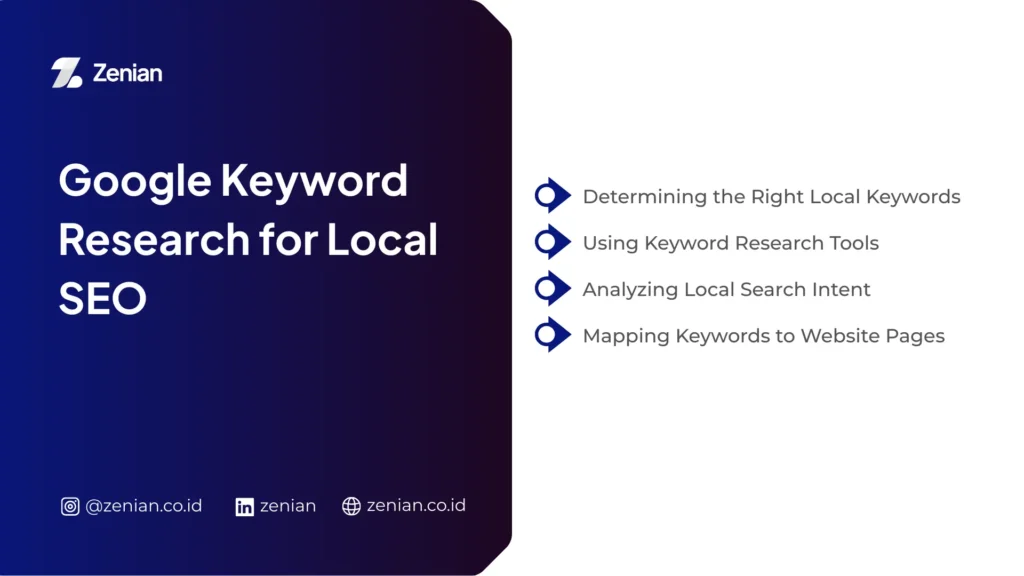
Google keyword research for local SEO is the process of finding search terms used by users when looking for products or services in specific areas. Here are important tips:
1. Determining the Right Local Keywords
The first step begins with identifying the main products or services offered by the business. This list is then combined with geographic elements to align with the target market location.
Some strategies that can be implemented include:
Using location names: Combine services with city, district, or neighborhood names, for example “restaurant in Makassar” or “pet shop Jogja.” This approach helps search engines understand the business service area.
Targeting “near me” searches: Use terms such as “nearest” or “near me” because Google’s algorithm automatically adjusts results based on user location.
Adding specific location details: Optimization should not stop at city names. Use neighborhood names, popular landmarks, or specific service areas to strengthen local relevance.
Considering variations of local terms: Each region has different search habits. Some users search for “AC service,” while others use the term “air conditioner repair.”
2. Using Keyword Research Tools
The research process becomes more accurate with the help of various SEO tools. These tools help identify keyword opportunities based on real user data.
Some commonly used tools include:
Google Autocomplete: When typing a service in the search box, Google displays popular keyword recommendations. This feature is effective for finding location-based long-tail keywords.
Google Keyword Planner: Although designed for paid ads, this tool provides monthly search volume data for specific locations, making keyword prioritization easier.
Semrush Keyword Gap: This tool compares website domains with competitors to identify untapped keyword opportunities.
Ahrefs or Semrush: Used to analyze competitor keywords, competition levels, and potential organic traffic a website can achieve.
Using tools ensures that research is data-driven rather than assumption-based.
3. Analyzing Local Search Intent
In addition to selecting keywords, understanding user search intent is a key factor in optimization success.
Several types of intent to analyze include:
Implicit local intent: Modern search engines understand local context even when users do not explicitly mention a location, such as when searching for “best breakfast place.”
Urgent needs: Many local searches have high urgency, such as searching for a technician service during sudden breakdowns.
Keywords can be classified into:
Informational → users seek information or tips
Navigational → users want to find a specific business location
Transactional → users are ready to buy or use a service
4. Mapping Keywords to Website Pages
After compiling the keyword list, the next step is mapping them to the website structure to ensure systematic optimization.
Strategies include:
Categorization and internal linking: Group related keywords to build a strong internal linking structure so visitors can easily navigate pages.
Creating location pages: Businesses with multiple branches should have dedicated pages for each location.
Developing blog and FAQ content: Use local keywords to create educational articles and FAQ pages that answer specific customer questions within the service area.
Website Optimization Strategies for Local SEO
Optimizing a website for local SEO helps businesses appear more relevant when users conduct location-based searches through search engines. The following strategies should be implemented consistently.
1. Optimizing Google Business Profile
Google Business Profile is the main foundation for businesses to appear on Google Maps and the Local Pack feature. Businesses need to complete their profiles thoroughly, including operating hours, business categories, service descriptions, and high-quality photos that represent business activities.
Active profile management is also essential. Regular information updates, new photo uploads, and responding to customer reviews help increase trust in Google’s algorithm.
2. Local On-Page SEO Optimization
On-page optimization focuses on internal website elements to align with location-based searches. This strategy involves placing geographic keywords naturally in important page sections.
Elements to optimize include:
Title Tag Meta Description Headings (H1, H2, H3) Page URL Structure
The website should also display an interactive location map from Google Maps on the contact or branch page. This step strengthens geographic signals so search engines clearly understand the business’s operational location.
3. Location-Based Content Optimization
Businesses operating in multiple service areas should create dedicated location pages. Each page must have unique content that specifically discusses services in that area.
Location-based content may include:
service explanations tailored to regional needs, local customer testimonials, service area information, FAQ sections relevant to the local community.
4. NAP Optimization (Name, Address, Phone)
Consistency of NAP (Name, Address, Phone) data is crucial in building business credibility. Search engines compare website data with information in business directories, social media, and third-party platforms.
Even small differences in writing addresses or phone numbers can reduce trust value. Google considers this consistency an indicator of prominence, reflecting a business’s reputation and validity within the local environment.
5. Building Local Backlinks
Backlinks from websites with high local authority significantly improve business reputation. Search engines treat these links as digital recommendations.
Ways to build local backlinks include:
collaborating with regional news media, partnering with local community blogs, joining local business associations, participating in community activities published online.
The more relevant the link sources are to the business location, the stronger the trust signals received by the website.
How Long Does It Take to See Local SEO Results?
There is no exact timeframe that guarantees when local SEO results will appear. Search engines like Google require time to crawl, index, and evaluate various digital signals before determining business positions in local search results.
This process happens gradually because algorithms continuously analyze information quality, business activity, and online trust levels. Therefore, ranking improvements do not occur instantly but develop alongside consistent optimization efforts.
However, several steps can help accelerate visibility growth, such as completing Google Business Profile with detailed data and collaborating with communities or local businesses to strengthen authority in the eyes of search engines.
Maximize Your Business Local SEO with Zenian!
Local SEO optimization helps build a digital presence that consistently reaches nearby customers. The right strategy helps businesses increase visibility, strengthen reputation, and open conversion opportunities from location-based searches.
PT Zenian Digital Lab is here as a partner to help guide the optimization process through local keyword research, Google Business Profile management, website optimization, and comprehensive strengthening of digital business signals.
It’s time to enhance your business potential. Consult your optimization needs with the Zenian team and start building stronger local search performance today.