

This article discusses how to make a website appear in Google search results. In reality, many website owners focus on design but forget that search engines operate based on algorithm systems, indexing, and ranking.
Through the right SEO techniques, you can help search engines understand and process your content effectively. This process requires understanding user behavior, website structure, and overall content quality. Read more below!
How to Make Your Website Appear in Google Search (Step by Step)
Each stage plays an important role in determining whether a page is worthy of appearing in search engines. Here are the steps you can apply systematically.
1. Make Sure Your Website Is Indexed by Google
A website can only appear on Google after the search engine finds and stores the page in its index.
Google performs a crawling process to read the content and then adds it to its search database.
2. Register Your Website with Google Search Console
Google Search Console is an essential tool for managing website performance on Google. This platform helps website owners understand how search engines view their site.
You can register through:
- Domain DNS verification
- Uploading an HTML file to the website server
Once activated, you can:
- View keyword performance that brings visitors
- Detect crawling errors
- Receive security notifications such as hacking indications
- Ensure the website is mobile-friendly
By utilizing this data, SEO management becomes more directed and analysis-based.
3. Submit a Website Sitemap
A sitemap functions as a navigation map that helps Google understand the overall structure of your website pages.
There are two commonly used types of sitemaps:
- XML Sitemap: helps search engines crawl faster
- HTML Sitemap: makes navigation easier for visitors
4. Use an SEO-Friendly URL Structure
A URL is not just a page address but also an informational signal for users and search engines.
Apply the following principles:
- Create simple and easy-to-understand URLs
- Include the main keyword naturally
- Use an ideal length of around 2–5 words
- Avoid complicated characters or random numbers
A clear URL structure helps improve relevance while enhancing user experience when reading search results.
5. Optimize Website Speed
Website speed is a major ranking factor in Google’s algorithm. Visitors tend to leave pages that load slowly.
The main optimization focus lies in Core Web Vitals metrics, such as:
- Largest Contentful Paint (LCP) → target under 2.5 seconds
- Cumulative Layout Shift (CLS) → target under 0.1 to maintain visual stability
Some optimization steps you can implement:
- Use quality servers such as LiteSpeed technology
- Enable caching systems
- Use a Content Delivery Network (CDN)
- Compress image sizes before uploading
6. Use the Right Keywords
A keyword strategy helps your website address audience needs precisely. This process begins with understanding user search intent.
Types of intent to understand:
- Informational → seeking knowledge or guidance
- Transactional → intending to purchase
- Navigational → looking for a specific website
Use long-tail keywords because they are more specific and have lower competition levels.
Keyword placement should be done naturally in:
- Meta title
- Meta description
- Headings (H1, H2, H3)
- The first 100 words of the content
7. Create High-Quality and Consistent Content
Content is the main foundation of website visibility in search engines. Google prioritizes pages that provide real value to readers.
Important principles in content creation:
- Write for humans, not just algorithms
- Provide unique, relevant, and solution-oriented information
- Build authority to gain natural backlinks
- Update or upload content consistently, ideally at least once a week
An active website signals to Google that the information presented remains relevant and worth recommending to users.
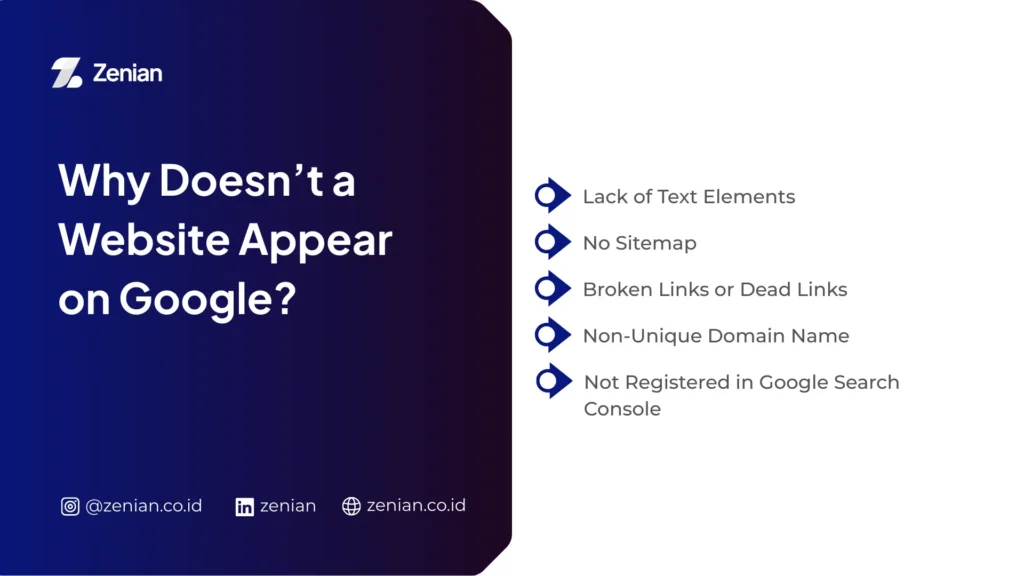
Why Doesn’t a Website Appear on Google?
Many website owners feel confused when a well-built site does not appear in Google search results. In fact, search engines do not immediately display a website without going through certain technical processes.
For a website to appear on Google, the search engine system must be able to read and understand the page content. Here are several factors that often hinder the process:
- Lack of Text Elements: Search engines read text-based content, not just visuals.
- No Sitemap: Without an XML sitemap, crawling becomes less optimal because search engines must manually guess the page structure.
- Broken Links or Dead Links: Google considers websites with many broken links as poorly maintained, reducing indexing and ranking opportunities.
- Non-Unique Domain Name: Domains or content that are too similar to other websites make it difficult for Google to determine the most relevant page version.
- Not Registered in Google Search Console: Websites not connected to Google Search Console are difficult to monitor in terms of performance.
A website that is already indexed does not necessarily appear easily on Google’s first page. Basic SEO strategy mistakes often become the main obstacle to search performance.
- Excessive keyword usage makes content appear unnatural. Google considers this practice manipulation and may lower page rankings.
- Large images, heavy scripts, or poor server configuration cause slow loading times and increase bounce rates.
- Websites without an SSL certificate (HTTPS) are considered less secure. Google prioritizes sites that protect user data through encrypted connections.
Therefore, understanding SEO fundamentals from the beginning is an important step in building a sustainable and competitive website.
Read Too: 8 Benefits of SEO for Businesses in the Digital Era
How Google Works in Displaying Websites
Google does not instantly display a website in search results. This search engine runs a structured series of technical processes to ensure users receive the most relevant, fast-access, and high-quality information.
Every website must go through several important stages before appearing on the Search Engine Results Page (SERP):
Crawling Process: The first stage begins with crawling, where Google sends an automated robot called Googlebot to explore web pages across the internet. The crawler system follows every link, including internal links between pages and image alt attributes.
Indexing Process: After crawling is complete, Google moves to indexing. At this stage, Google analyzes page content and stores it in a large database called the search index.
Ranking Process: The next stage is ranking, which determines a website’s position on the Search Engine Results Page (SERP). Google uses hundreds of ranking factors to determine positions.
This is influenced by Google’s algorithm, a complex mathematical system that continuously evolves to evaluate millions of websites automatically. The system determines which pages deserve the best positions.
SEO (Search Engine Optimization) serves as an optimization strategy to align websites with these algorithm standards. Optimization focuses not only on keywords but also on content quality, site security, technical structure, and user experience.
Important SEO Techniques to Improve Website Ranking
In general, SEO practices are divided into three main pillars: On-Page SEO, Technical SEO, and Off-Page SEO. All three complement each other in building overall website performance, from content quality to external reputation.
On-Page SEO
On-Page SEO focuses on optimizing elements directly within website pages. This strategy helps search engines understand the content topic while improving reader comfort.
Actions in On-Page SEO include:
- Title and Meta Description Optimization: Use keywords naturally in meta titles and meta descriptions.
- Proper Heading Usage: Structure content hierarchically. Use H1 as the main title, followed by H2 and H3 as supporting subheadings.
- Internal Linking: Connect relevant pages within the website to help search engines understand site structure and distribute page authority.
Technical SEO
Technical SEO focuses on technical aspects to ensure optimal crawling and indexing:
- Mobile Friendly: Google applies mobile-first indexing, so websites must be responsive on mobile devices. Adaptive design and fast mobile loading times are crucial ranking factors.
- Core Web Vitals: Google uses Core Web Vitals metrics to measure user experience, including Largest Contentful Paint (LCP) for loading speed, Interaction to Next Paint (INP) for responsiveness, and Cumulative Layout Shift (CLS) for visual stability.
- Schema Structure: Use schema markup to help search engines understand page data context. Implementation increases opportunities to appear in special SERP features.
Off-Page SEO
Off-Page SEO includes optimization activities outside the website to improve authority and credibility.
- Quality Backlinks: Obtain backlinks from credible and relevant websites. High-quality external links signal that content is considered trustworthy, improving overall website reputation.
- Brand Mentions: Build brand reputation through mentions on digital platforms, forums, and online communities. Brand mentions help search engines recognize popularity and public trust.
- Content Distribution: Consistently distribute content through social media. This activity generates additional traffic and opens collaboration opportunities with influencers or industry experts to expand audience reach.
Website Optimization Strategies to Rank Faster on Google
Here are strategies to help your website grow faster in search engines:
- Keyword Research: Keyword research is the main foundation before creating content. You should not only look for popular keywords but also understand audience needs and search behavior.
- Sustainable SEO Optimization: SEO is a long-term strategy. Websites usually need several months to a year before showing significant improvement.
- Update Old Content: Google favors active websites that update information. Updated old content can regain traffic without creating new articles from scratch.
- Monitor Website Performance: SEO strategies are not optimal without data analysis. Monitoring helps you understand what works and what needs improvement.
SEO Optimization Mistakes to Avoid
Here are common SEO mistakes to avoid to maintain optimal website performance:
- Keyword Stuffing: Inserting keywords excessively into content, meta tags, or headers makes writing unnatural and hard to read.
- Duplicate Content: Duplicate content occurs when articles are too similar or identical to other websites, making it difficult for Google to determine which page deserves to appear in search results.
- Slow Website: Websites often become slow due to large image sizes, unoptimized scripts, excessive CSS elements, or additional applications that burden the system.
- Not Mobile Friendly: With mobile-first indexing, Google prioritizes mobile versions for indexing and ranking. Non-responsive websites risk losing search positions.
How Long Does It Take for a Website to Appear on Google?
Generally, significant ranking improvements take several months to one year. The duration depends heavily on optimization consistency, content update activity, and ongoing promotional strategies.
New websites usually require an adaptation phase before gaining Google’s trust. Therefore, the best approach is building a stable website foundation rather than pursuing instant results.
Although it takes time, the following steps can help accelerate indexing and improve visibility. Internal links help search engines understand page structure, while backlinks from credible websites increase overall domain authority.
Want Your Website to Appear on Google’s First Page?
After learning how to make a website appear in Google search results, start implementing the steps provided. However, optimization requires time and specific expertise, so working with a professional partner can be more effective.
Zenian is here as your digital growth partner. Through a Search Engine Optimization approach, integrated digital marketing strategies, and modern UI/UX-based website development, Zenian helps businesses grow measurably and sustainably.
If you want to learn the best strategy according to your current business condition, consult directly with the team at PT Zenian Digital Lab. It’s time to unlock greater opportunities!
Read Too: 15 Search Engines Other Than Google: Best Alternative