


Understanding the differences between a website and a blog is crucial before you build a strategy for an effective online presence. Although they are often thought to be the same, the two have different functions, goals, and characteristics.
Websites are generally used to professionally display official information, business profiles, or services, whereas blogs focus more on publishing regularly updated content to attract and engage with an audience.
By recognizing the advantages of each platform, you can determine a more precise strategy that fits your needs. So, what exactly sets a website and a blog apart, and which one is best suited to support your goals?
What Are Websites and Blogs?
A website is a collection of interconnected web pages under a single domain that can be accessed via the internet. Website owners typically use this platform to display business information, portfolios, product catalogs, and corporate services. Because it has a broad scope, a website can contain various types of pages, including a blog, an online store, or a company profile page. Most information on a website is also relatively static and is only updated when specific changes occur.
Meanwhile, a blog is a specific type of website that focuses on publishing content periodically. The term “blog” originates from “web log,” which is a medium used to share articles, opinions, guides, photos, or videos with an audience. Through a blog, site owners can convey the latest information, share experiences, or review specific topics in greater depth. Because it continuously presents fresh content, a blog has a more dynamic character compared to general websites.
Differences Between Websites and Blogs
Even though both exist as digital pages accessible via the internet, websites and blogs have different purposes, structures, and management methods. Here are several differences you need to understand:
1. Differences Based on Purpose of Use
Business owners usually use a website to strengthen their professional image, introduce their company, showcase products or services, and facilitate transaction processes. A website helps build visitor trust in a brand.
Conversely, a blog focuses more on delivering information and building relationships with the audience. Through relevant and useful articles, blog owners can share insights, experiences, or opinions related to a specific field.
2. Differences in Content Structure
On a blog, content is displayed based on chronological order of publication. The newest articles appear at the very top so visitors can instantly find the latest information. Additionally, blogs usually group articles by specific categories or tags to make them easier to browse. The writing style also tends to be more casual, communicative, and relatable to readers.
On the other hand, a website organizes information into dedicated pages that do not depend on the publication date. Some commonly found pages include:
- Home
- About Us
- Services
- Contact Us
- Portfolio
This structure helps visitors find crucial information more quickly. Because it focuses on delivering official information, a website generally uses more formal and professional language.
3. Differences in Update Frequency
A blog requires regular content updates to stay relevant and maintain the audience’s attention. Many blog managers publish new articles every week, or even every day, to maintain traffic performance and increase visibility on search engines.
In contrast, a website does not require updates as frequently as a blog. Website owners usually only make changes when there is new information, such as adding services, changing the company address, updating products, or adjusting contact information.
4. Differences in User Interaction
Blogs allow for two-way communication between the writer and the readers. Many blogs provide a comment section that allows visitors to ask questions, provide feedback, or discuss the topics being covered.
On the flip side, websites generally implement one-way communication. Visitors come to obtain specific information, while the company provides various official communication channels if needed.
5. Differences in SEO Focus and Traffic
In a Search Engine Optimization (SEO) strategy, a blog is essential because it can generate many new pages that target various keywords. The more frequently a blog publishes quality content, the greater the chances the website has of gaining traffic.
Meanwhile, a website focuses more on optimizing the homepage, service pages, and overall site structure. Because its number of pages tends to be limited and more static, a website needs the support of a blog to boost its visibility in search results.
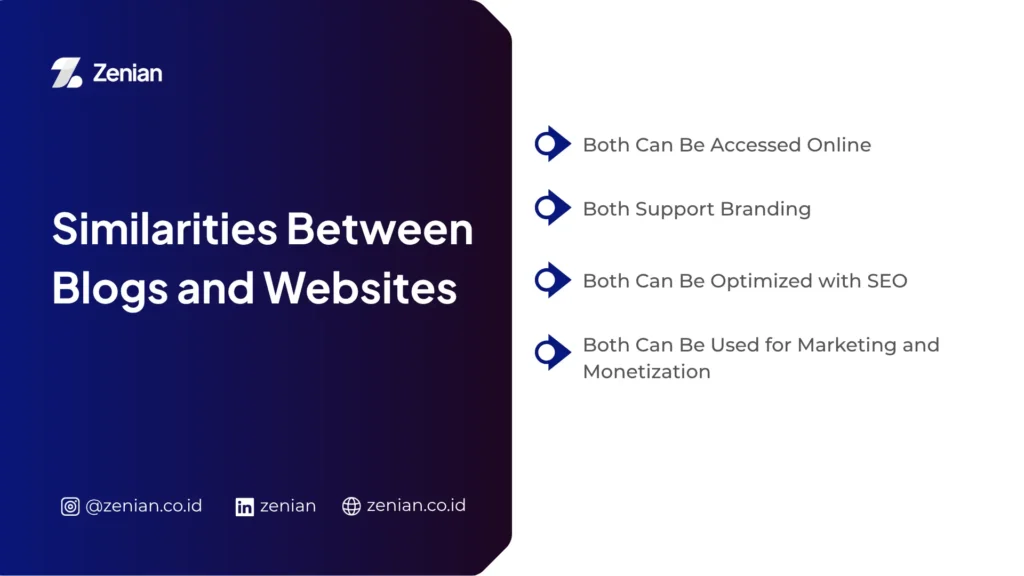
Similarities Between Blogs and Websites
Although blogs and websites have different functions, they still share many similarities as digital media. Here is a list of their similarities:
1. Both Can Be Accessed Online
Both blogs and websites consist of a collection of pages linked under a single domain. Internet users can access both at any time through a browser by typing the domain address or finding them through search engines like Google. This ease of access allows information, products, or services to reach a wider audience across geographical boundaries. Therefore, many individuals and companies utilize both blogs and websites as 24-hour information hubs.
2. Both Support Branding
Blogs and websites both help build an image and identity in the digital world. Companies usually use websites to introduce their business profile, showcase services, and strengthen credibility in the eyes of potential customers. Meanwhile, blogs help individuals showcase expertise, share insights, and build a reputation in a particular field. Through informative and consistent articles, a blog can increase audience trust while strengthening personal branding.
3. Both Can Be Optimized with SEO
To be easily discovered by potential visitors, both blogs and websites require Search Engine Optimization (SEO) strategies. This optimization helps pages perform better in Google search results and other search engines. On a blog, optimization focuses on creating quality content, using relevant keywords, and updating articles regularly. Meanwhile, a website requires optimization regarding page structure, loading speed, navigation, and service pages.
4. Both Can Be Used for Marketing and Monetization
In addition to being information media, blogs and websites can also help generate revenue and support digital marketing strategies. Many businesses leverage both to reach potential customers and increase conversions. Some commonly used methods include:
- Affiliate Marketing: Promoting products or services belonging to other parties to earn a commission.
- Digital Advertising: Such as Google AdSense, which provides income from ad impressions or clicks.
- Direct Sales: Selling physical or digital products directly to customers.
- Professional Services: Offering services like consulting, design, training, or other specialized solutions.
Read Too: How to Create a Free Blog: A Complete Guide for Beginners
Advantages and Disadvantages of Websites and Blogs
Both offer different benefits and come with their own challenges in management. You can choose the platform that best fits your goals, resources, and digital strategy.
1. Advantages of a Website
A website can deliver a professional and credible impression from the very first time a visitor opens the page. Some advantages of a website include:
- Building a stronger professional image in the eyes of potential customers or business partners.
- Providing the freedom to arrange the design, layout, and features according to your needs.
- Supporting various business features, such as product catalogs, order forms, and payment systems.
- Storing important information long-term without being affected by the chronological order of content publication.
2. Disadvantages of a Website
Despite offering many advantages, a website also requires significant investment and management. The creation process is generally more complex compared to a blog, especially if it requires fairly complete features. Some disadvantages of a website include:
- Requiring fees for a domain and hosting that must be renewed periodically.
- Requiring technical understanding of website management, including hosting configurations, domains, and code such as HTML, CSS, or JavaScript.
- Tending to have one-way communication because not all pages provide comment features.
- Being harder to gain organic traffic if the content is rarely updated.
Therefore, website owners need to combine other strategies, such as SEO optimization or digital marketing, so that the website remains easy for potential visitors to find.
3. Advantages of a Blog
A blog offers a simpler way to build a digital presence. Even beginners can create and manage a blog without needing deep technical skills. Some advantages of a blog include:
- Easy to create and manage through various user-friendly platforms.
- Allowing direct interaction with readers through the comment section.
- Helping to increase visibility on search engines through routine content publication.
- Providing the freedom to use a more casual, personal, and communicative tone of language.
4. Disadvantages of a Blog
Behind its simplicity, a blog also demands high consistency. Without regular content updates, a blog will struggle to maintain reader interest and search engine performance. Some disadvantages of a blog to consider are:
- Compelling the owner to continuously produce new content periodically.
- Having limitations in design and features, especially when using free platforms.
- Making older articles harder to find due to the chronological publication system.
- Less suitable for needs that require a highly formal or corporate impression.
If not managed well, a blog can lose relevance and experience a decline in visitors over time.
Which is Better: A Blog or a Website?
Many people look for answers regarding which is better between a blog and a website. To make it easier to decide, consider the following points:
1. Choosing Based on Business Goals
If your main goal is to build a professional image and provide official information to customers, a website is the more appropriate choice. Conversely, a blog is more suitable if you want to attract the attention of potential customers through continuously updated content. You can share educational articles, industry insights, practical tips, or reviews relevant to your audience’s needs.
2. Blog vs. Website for Personal Branding
For individuals looking to build personal branding, a blog offers more space to showcase expertise and character. The more consistent the shared content is, the easier it is for the audience to recognize your competence. On the other hand, a website is more suitable for displaying a professional portfolio. Designers, photographers, architects, and freelancers often use websites to showcase their best work.
3. Websites and Blogs for SEO and Organic Traffic
Blogs are usually superior at driving organic traffic because they allow you to publish new content regularly. Each article can target different keywords, making the chances of appearing in search results much higher. Meanwhile, a website acts as the main information hub that strengthens business credibility. However, without regular content updates, a website is often harder to compete with a blog in acquiring organic traffic.
4. Can a Website and a Blog Be Combined?
Of course they can, and this strategy is actually the most widely used choice by modern businesses. You can place a blog as a section of the main website so that both platforms work simultaneously. This combination not only increases visibility on search engines but also helps convert visitors into high-potential customers. That is why many businesses choose to merge a website and a blog to get the maximum benefits in terms of branding, organic traffic, and conversion opportunities.
Build a Professional Website and Blog with Zenian!
Understanding the differences between a website and a blog will help you choose the platform that best suits your business needs and goals. Since both have complementary functions, combining a website and a blog can be the best strategy.
If you want to build a professional website while optimizing a blog to bring in traffic and potential customers, the PT Zenian Digital Lab team is ready to help you design the right digital strategy tailored to your business needs.
Read Too: How to Create a Blog on WordPress: A Complete Guide for Beginners