
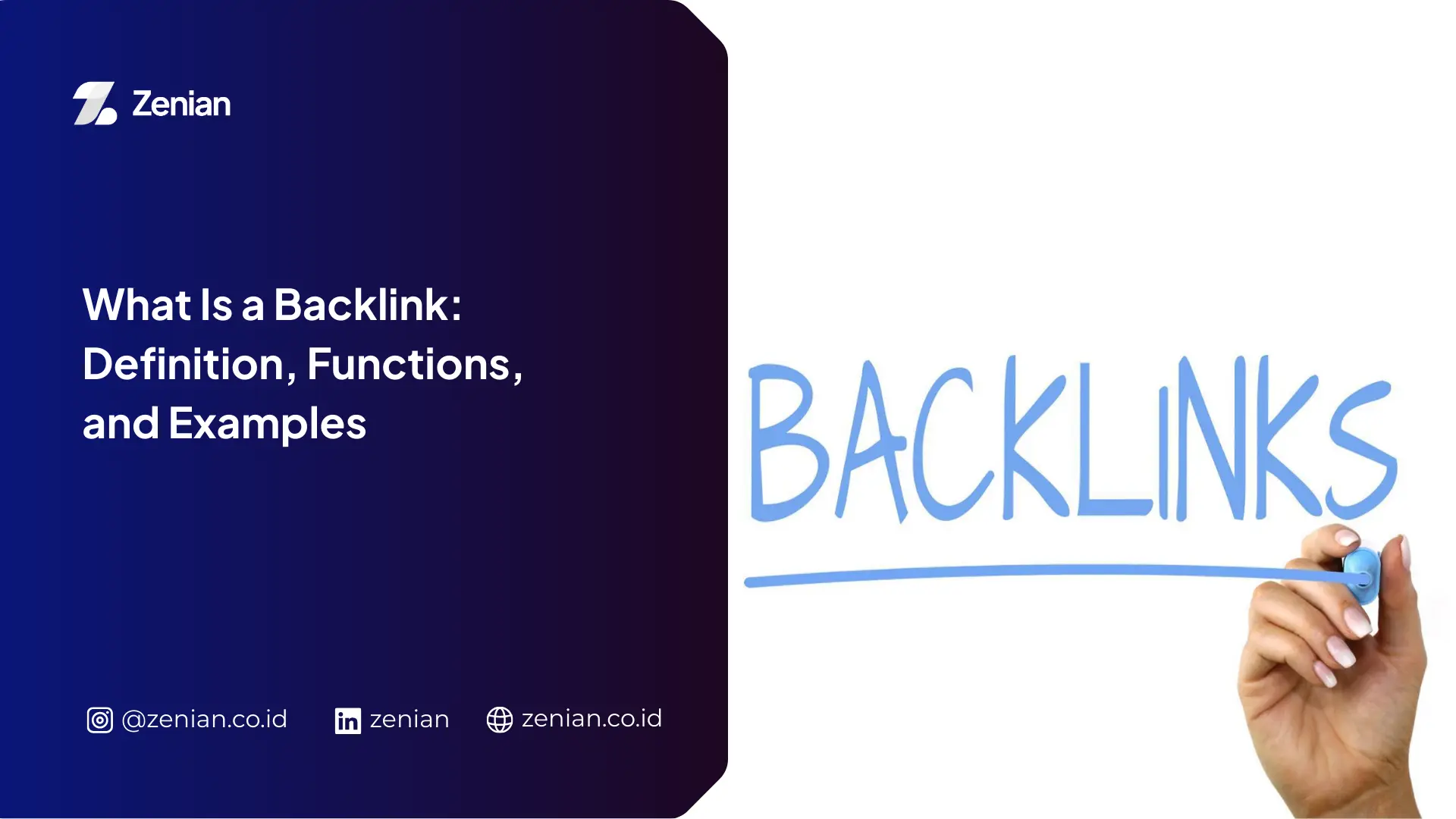
You may often hear the term “what is a backlink” when learning about SEO and website optimization strategies. This article invites you to understand the basic concept in a simple way before moving into a deeper discussion.
You will see how the function of backlinks influences search engine rankings and why many digital marketing practitioners rely on them. We also discuss the various benefits of backlinks for site credibility and organic traffic opportunities.
What Is a Backlink?
A backlink is a link on one website that points to another website. Many digital practitioners also refer to it as an inbound link or external link. This link appears when a domain includes a clickable link directing users to another domain as an information reference.
The difference between a backlink and an internal link lies in the direction of the link. An internal link connects two pages within the same domain. This strategy helps visitors find related information and increases session duration.
In Search Engine Optimization (SEO) strategy, backlinks function as a signal of trust or a vote of confidence for search engines.
Here is how backlinks work to improve website performance:
- Providing credibility signals
- Improving ranking
- Accelerating crawling and indexing processes
- Transferring authority (link juice)
- Generating referral traffic
Functions and Benefits of Backlinks for Websites
After understanding the basic concept, it is important to see how backlinks play a real role in developing website performance. Below is an explanation of their functions and benefits:
1. Increasing Domain Authority
Domain authority indicates the level of trust and credibility of a website in the eyes of search engines. When a website obtains high-quality backlinks, it builds a stronger authority profile.
Search engines evaluate links as indicators of a domain’s relevance and reputation compared to competitors. In this process, link quality becomes the primary factor.
One backlink from a highly reputable site has a far greater impact than many links from low-quality websites.
2. Improving SERP Rankings
Backlinks are one of the main factors in determining a website’s position on the Search Engine Results Page (SERP).
When other sites link to your content, search engines interpret this action as a trust signal that the page is worthy of recommendation.
The more relevant and trustworthy sites that provide links, the greater the chance the page will appear in top positions for specific keywords.
3. Increasing Organic Traffic
Improved search result positions significantly drive organic traffic growth. Websites that occupy top positions have a much higher click-through rate compared to lower-ranked pages.
The higher the ranking, the greater the opportunity for users to visit the page. In addition to supporting search engine performance, backlinks also generate referral traffic.
When users read articles on other websites and click available links, they are directed to the referenced website. This strategy allows websites to gain relevant new visitors without relying entirely on search engine algorithms.
4. Enhancing Credibility and Brand Awareness
Backlinks also serve as recognition of content quality. When other sites provide links, the action reflects a recommendation or vote of confidence in the information presented.
Both search engines and users see this as an indicator that the content is trustworthy. Over time, the presence of links across various platforms increases brand visibility among a broader audience.
Websites that are frequently referenced by relevant sites are more easily perceived as authorities or experts in their field. This condition directly strengthens user trust while continuously increasing brand awareness.
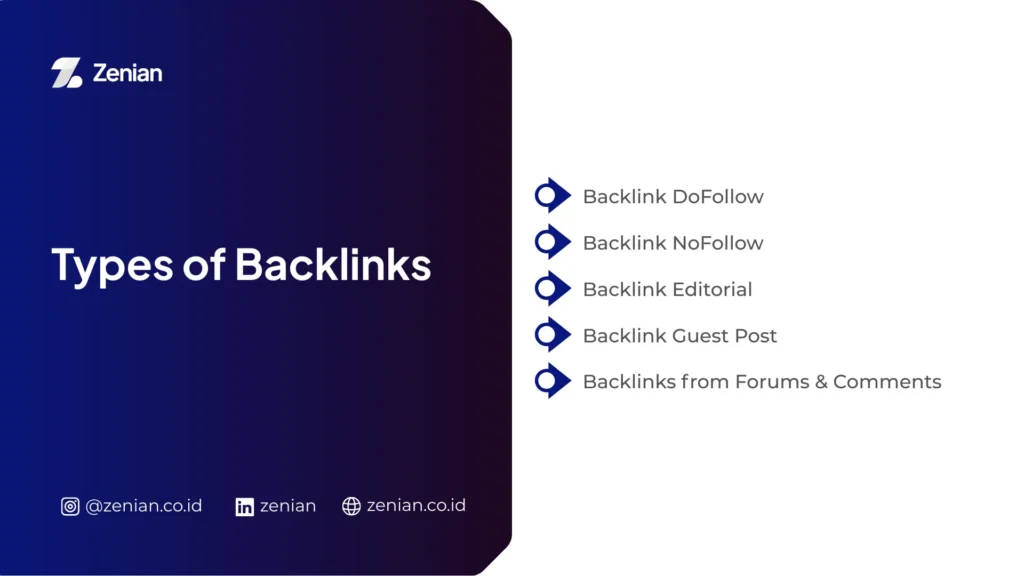
Types of Backlinks You Need to Know
Search engines do not evaluate all links in the same way. Therefore, understanding backlink types helps you build a safer, more effective, and sustainable optimization strategy.
1. DoFollow Backlinks
DoFollow backlinks allow search engines to crawl and index the destination page directly. This type of link passes authority or link juice from the referring site to the receiving site.
When a website gains many high-quality DoFollow backlinks, its opportunity to improve position in the SERP becomes greater.
2. NoFollow Backlinks
NoFollow backlinks use a special attribute that instructs search engines not to count the link for ranking evaluation.
Although they do not pass page authority, NoFollow backlinks still play an important role. They can generate traffic, expand brand visibility, and keep the backlink profile looking natural in the eyes of Google’s algorithm.
3. Editorial Backlinks
Editorial backlinks are known as natural backlinks. Other website owners voluntarily link to content because they consider the information relevant, high-quality, and worthy of reference.
This type of backlink has high value because it appears without requests, link exchanges, or payments. Search engines view it as an organic recommendation based on content quality, often providing a positive impact on site credibility.
4. Guest Post Backlinks
Guest post backlinks are obtained by writing articles as a contributor on other websites. Writers usually insert a link to their own website within the article or author bio section.
This strategy helps reach new audiences while building authority within a specific niche. Optimal results are achieved when guest posts are published on relevant, reputable websites with audiences aligned to the topic.
5. Forum & Comment Backlinks
Backlinks can also be obtained through active participation in online communities such as discussion forums or blog comment sections.
Comment backlinks appear when users leave responses on other articles or blogs. While this practice can attract reader attention, excessive use without meaningful contribution is often considered spam and may harm website reputation.
Read Too: 7 Ways to Make Your Website Appear in Google Search with SEO
How to Build Effective Backlinks
Effective link building practices always focus on quality, relevance, and user experience. Below are several strategies proven to support sustainable SEO performance.
1. Guest Posting on Relevant Sites
Guest posting involves writing articles for publication on other websites to obtain links back to your site. This method allows you to control content quality while delivering messages aligned with the audience.
Choose websites with relevant niches and strong domain authority so search engines evaluate the link as high-quality.
2. Creating High-Quality, Link-Worthy Content
Search engines highly value backlinks that appear naturally through editorial content. This means other websites link to your article because it truly deserves reference.
High-quality content usually has the following characteristics:
- Original research results or credible industry surveys
- Visual assets such as infographics or educational videos
- Comprehensive guides and technical tutorials
- Free tools or online calculators that assist users
3. Business Directories and Local Listings
Registering your website on business directory platforms is a strategic step to strengthen your backlink profile, especially for local businesses.
Trusted platforms such as Google My Business or Yellow Pages help increase visibility while building search engine trust.
4. Outreach & Collaboration with Influencers or Publishers
Outreach strategies emphasize relationship building with bloggers, publishers, or industry experts. You can contact parties with relevant audiences to open opportunities for content collaboration or joint publications.
One effective technique is identifying unlinked brand mentions, which are brand name mentions without a link.
You can contact the article author and request that they add a link to your website. This approach often develops into mutually beneficial long-term collaborations.
5. Broken Link Building
Broken link building takes advantage of opportunities from broken links on other websites. This strategy begins by finding pages displaying 404 errors using SEO tools.
After identifying inactive links, you can contact the website owner and offer relevant content as a replacement.
This approach is effective because you help improve their page quality while naturally gaining high-quality backlinks.
Examples of Good and Bad Backlinks
High-quality backlinks appear naturally because the content provides real value to readers. This strategy prioritizes information quality rather than simply pursuing link quantity.
However, not all backlinks bring positive impact. Some practices are considered manipulative by search engines and may lower site rankings, such as:
- Link Scheme: Buying and selling links or using Private Blog Networks (PBNs) to manipulate domain authority.
- Low-Quality Directories: Submitting sites to directories without content curation, resulting in links without informational value.
- Comment and Forum Spam: Mass posting links in comment sections or forums without meaningful contribution.
- Excessive Link Exchanges: Large-scale link swapping that creates unnatural linking patterns.
- Toxic Backlinks: Links from suspicious sites, malware-infected domains, or completely unrelated niches that reduce trust signals.
Therefore, SEO practitioners usually evaluate several important indicators to ensure a backlink truly provides value.
Tools for Backlink Analysis
Various analysis tools help you identify who links to your website, evaluate link quality, and measure their impact on domain authority.
Google Search Console
Google Search Console is the primary free option for website owners who want to analyze backlinks. After verifying your site, the system displays important data in the “Links” menu.
Through this feature, you can see:
- Websites linking to your site
- Pages receiving the most external links
- Anchor text usage from referring websites
This data helps you understand how search engines interpret relationships between pages and evaluate content popularity.
Ahrefs / SEMrush / Moz
Besides free services, many digital practitioners use professional SEO platforms for deeper analysis. Three popular platforms are Ahrefs, SEMrush, and Moz.
- Moz: Provides Moz Link Explorer and introduces the Domain Authority (DA) metric.
- Ahrefs: Through Site Explorer, you can view total backlinks, referring domains, and Domain Rating (DR).
- SEMrush: The Backlink Analytics feature allows competitor comparison, link growth trend analysis, Authority Score evaluation, and toxicity score identification.
How to Read a Backlink Profile
Analyzing a backlink profile is not just about counting links. You need to understand quality, growth patterns, and overall link network health.
Important aspects to consider include:
- Anchor Text Distribution: Ensure anchor text usage appears natural. Excessive keyword repetition may be considered manipulative.
- Follow vs NoFollow Ratio: A healthy profile typically includes a combination of both types.
- Authority Score: One backlink from a high-authority site is often more valuable than many from low-quality domains.
- Link Velocity: Monitor backlink growth over time. Sudden spikes from irrelevant sites may indicate spam attacks.
- Niche Relevance: Links from websites within relevant industries provide stronger contextual signals.
- Toxicity Audit: Use audit features to classify backlinks as healthy, neutral, or toxic.
Want Your Backlink Strategy to Increase Traffic & Rankings?
Building a strong backlink profile helps establish authority, credibility, and trust signals in the eyes of search engines. High-quality backlinks improve SERP positions, expand brand visibility, and consistently generate referral traffic.
PT Zenian Digital Lab offers 360° Digital Marketing services to help design integrated SEO strategies. Consult your SEO needs today and start optimizing your business’s digital growth with an expert team.
Read Too: 8 Benefits of SEO for Businesses in the Digital Era