


Have you ever wondered how search engines work when they find information in just a matter of seconds? Behind that convenience lies a complex process involving crawling, indexing, and ranking technologies.
You may not see it, but search engines continuously work to collect, organize, and display the most relevant data according to your needs. This article will explain how this system operates, its functions, and the processes that happen behind the scenes.
By understanding the basic concept, you can use search engines more wisely to obtain accurate, fast, and relevant information based on your search goals. Read more below!
What Is a Search Engine? (Complete Definition)
A search engine is a software system designed to help you find information on the internet based on keywords or queries you enter.
This system acts as a bridge between users and various types of digital information, ranging from web pages, images, videos, news, to documents such as PDFs.
Today, various search engines are widely available and used by people. Each has its own features and advantages:
- Google is the most popular search engine in the world because it can understand natural language and display relevant results quickly.
- Bing is developed by Microsoft and is directly integrated with the Windows operating system and the Edge browser.
- Yahoo! is one of the early-generation search engines that now utilizes Bing’s technology to deliver search results.
- DuckDuckGo offers a more secure search experience by focusing on user privacy without tracking activities.
- Baidu dominates the market in China and is often considered the main alternative to Google in that country.
In today’s internet landscape, search engines play a very important role in various aspects of digital life:
- They serve as the main gateway for users to access information, whether searching for news, products, or answers to questions.
- They improve search efficiency by filtering and displaying the most relevant information within seconds.
- For businesses, search engines help websites become more discoverable through Search Engine Optimization (SEO), increasing visibility without always relying on paid ads.
- Modern search engines can also personalize results based on location, language, and user devices, providing a more relevant and tailored experience.
Functions of Search Engines in the Digital World
Search engines function as software systems that help users find information on the internet based on keywords or queries. Their roles include:
1. Function for Users
For internet users, search engines make it easy to access various types of information instantly. This process improves efficiency because search engines can filter millions of data points in seconds.
Additionally, search engines tailor results based on user context. The system considers geographic location, language, device, and previous search history.
2. Function for Businesses and Websites
For business owners and website managers, search engines are essential tools to increase online visibility. Websites that appear in search results have a greater chance of being discovered by potential customers looking for specific products or services.
Search engines also help drive business growth by increasing organic traffic and generating leads.
Moreover, appearing on the first page of search results strengthens credibility and builds public trust, making a business look more professional and reliable.
3. Role in SEO
In the context of Search Engine Optimization (SEO), search engines act as quality evaluators of websites. They assess various factors such as content relevance, information quality, site security (like HTTPS), and user experience.
Search engines also filter information through crawling and indexing processes to ensure that only high-quality content enters their database.
Furthermore, modern systems continue to improve their ability to understand user intent. They can distinguish whether users want information, transactions, or navigation, making results more accurate and relevant.
How Search Engines Work in General
In general, search engines use automated robots such as crawlers, bots, or spiders to explore billions of web pages and collect data. The system then processes this data using complex algorithms to display results that match user needs.
Search engines have two main components:
- Invisible components: including crawling bots, search algorithms, and data processing systems that operate behind the scenes.
- Visible components: the search results page where users enter keywords and see results instantly.
Search engines perform three main processes continuously to deliver optimal search results. With this structured process, they can present accurate information in a very short time.
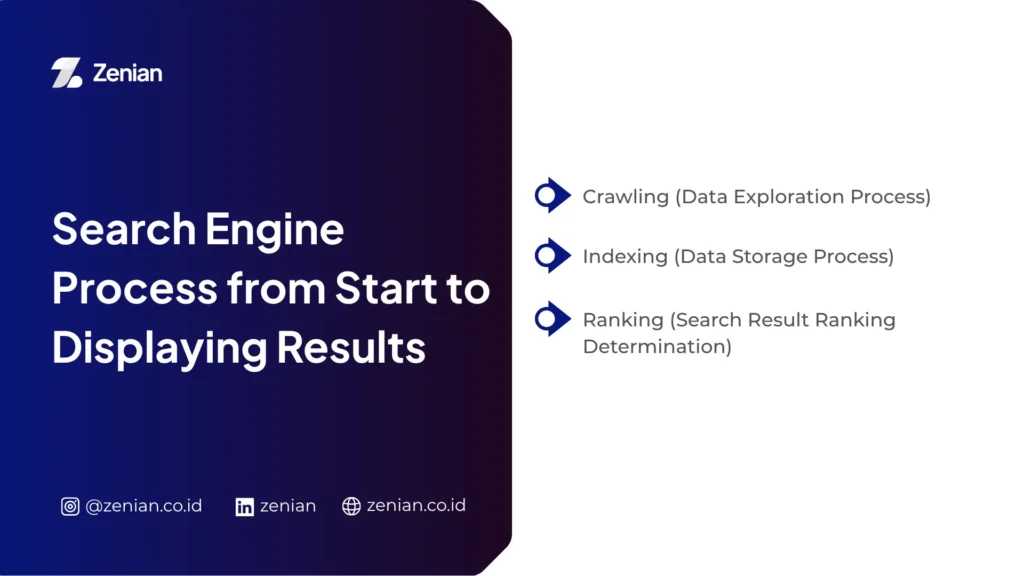
Search Engine Process from Start to Displaying Results
Search engines go through three main stages to discover, store, and present the most relevant information. These stages include crawling, indexing, and ranking.
1. Crawling (Data Exploration Process)
At this stage, search engines send automated programs such as crawlers, bots, or spiders to explore web pages across the internet.
Bots collect data by following links from one page to another, similar to how users navigate between websites. This process starts from known URLs and expands as new pages are discovered through links.
Bots also use sitemaps submitted by website owners to better understand site structure.
During crawling, bots gather elements such as text, images, and videos, and perform rendering to fully understand page content.
However, not all pages can be accessed. Files like robots.txt may restrict bot access, and technical issues such as slow servers or network errors can hinder the process.
2. Indexing (Data Storage Process)
After collecting data, search engines proceed to indexing, which involves storing and organizing information into a massive database called an index.
They analyze important elements such as title tags, heading structures (H1, H2, H3), images, and metadata to understand the topic and context.
This process also includes canonicalization to determine the main version of a page, ensuring the most appropriate version appears in search results.
Not all pages are indexed. Search engines only store high-quality pages, while low-quality content or pages with noindex tags are usually excluded.
3. Ranking (Determining Search Result Positions)
In this stage, search engines determine the order of pages displayed in search results based on user queries.
Algorithms consider several important factors:
- Content relevance to user intent
- Page quality and authority
- Originality of content and backlinks from other sites
User experience also plays a role, including page speed, HTTPS security, ease of navigation, and mobile responsiveness.
Search engines also personalize results based on context such as location, language, device, and search history.
By processing billions of data points in seconds, search engines deliver highly relevant results almost instantly. This entire process runs automatically, meaning organic search results are determined by quality and relevance, not direct payment.
Factors That Influence How Search Engines Work
Search engines use complex algorithms to filter and display the most relevant web pages. The ranking of a page is influenced by several factors:
1. Keyword Relevance
Search engines prioritize keyword relevance to match user queries with available content. They analyze keyword usage in elements such as title tags, headings, URLs, and meta descriptions.
They also evaluate whether keywords are used naturally within the content. Modern systems also understand search intent, identifying whether users want information, make a purchase, or visit a specific site.
2. Content Quality
Content quality is a major ranking factor. Informative, accurate, and original content is more likely to rank well.
Search engines use the E-E-A-T concept (Experience, Expertise, Authoritativeness, Trustworthiness) to evaluate credibility.
Content structure also matters, including short paragraphs, bullet points, and multimedia elements like images or videos.
3. Backlinks and Website Authority
Backlinks are considered indicators of trust from other websites. When a site receives links from credible sources, it is seen as more authoritative.
However, quality matters more than quantity. Links from reputable sites have a positive impact, while low-quality or manipulative links can harm rankings.
4. User Experience (UX)
Search engines evaluate user experience to ensure comfort when accessing a website. Page speed and visual stability (Core Web Vitals) are key factors.
Mobile-friendliness is also crucial, as most users access the internet via mobile devices.
Security features like HTTPS increase trust, while clear navigation helps users find information easily.
Search engines also monitor user interactions such as dwell time and click-through rate (CTR) to assess content usefulness.
The Relationship Between Search Engines and SEO
Understanding how search engines work is essential for website owners and businesses to ensure their content reaches the right audience.
This understanding helps identify opportunities and avoid mistakes in optimization strategies.
Key benefits include:
- Identifying Areas for Improvement: Website managers can analyze processes from crawling to ranking to find areas that need enhancement.
- Improving Discoverability: Websites become easier to find by users searching for products, services, or solutions.
- Solving Technical Issues: Helps address problems such as crawling failures, indexing issues, or poor search display.
- Understanding System Fairness: Search engines like Google operate automatically using algorithms and do not accept payments to increase crawling frequency or rankings.
Optimize Your Website According to How Search Engines Work
In conclusion, understanding how search engines work through crawling, indexing, and ranking is a fundamental and crucial step to ensure a website appears relevant, fast, and useful in search results.
By implementing proper SEO strategies ranging from keyword optimization, content quality, authority building, to user experience, websites can increase visibility and gain stable organic traffic without relying on paid ads.
Since algorithms continuously evolve, consistent and professional management is essential. Collaborating with service providers like PT Zenian Digital Lab can help optimize digital performance while driving sustainable business growth.
Read Too: Is Yahoo a Search Engine? Explanation and Its Features